
Blog
Your one wild and precious life – bringing the wild indoors
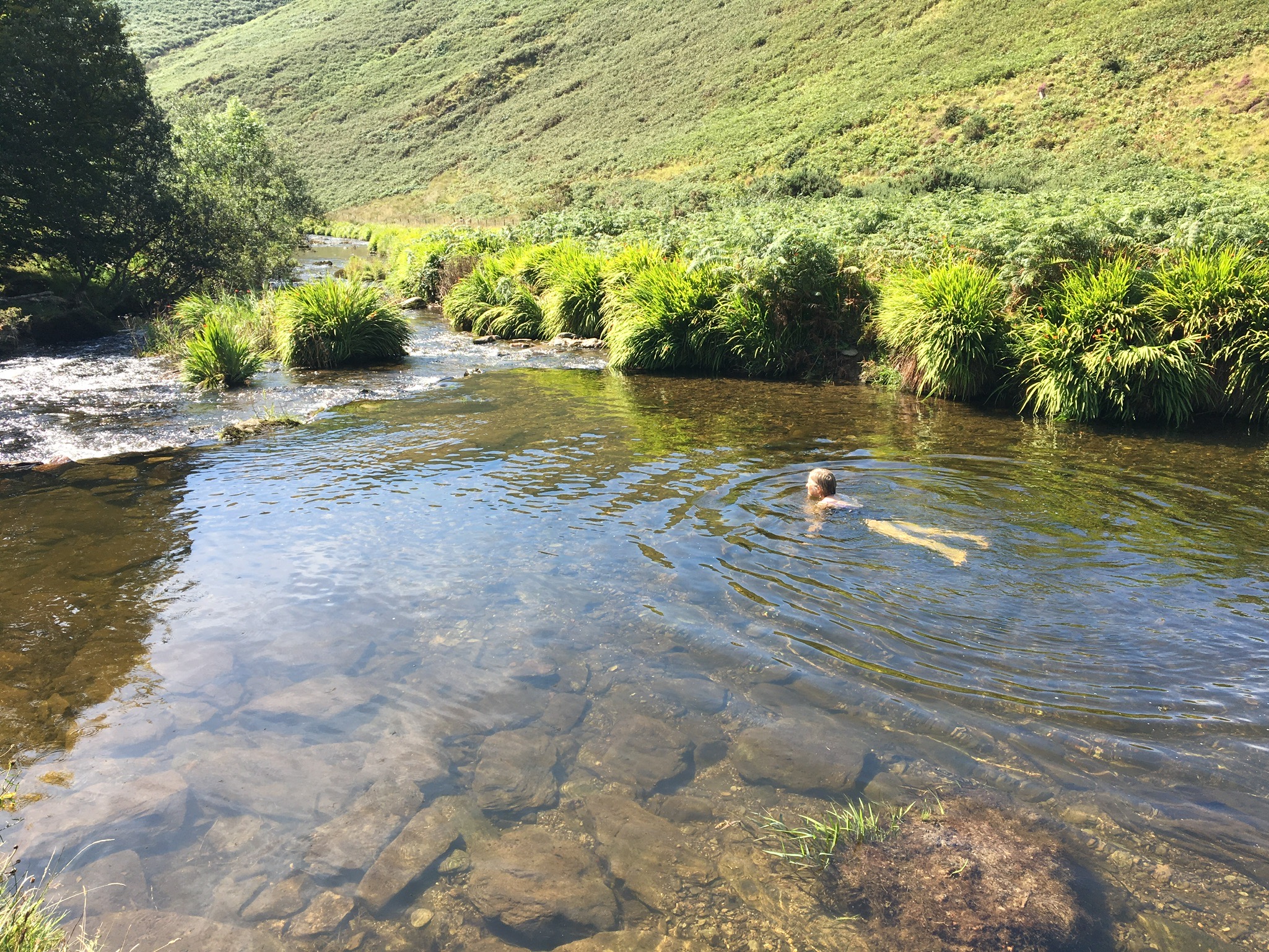
Swimming in Exmoor in August 2017
Exmoor – August bank holiday weekend
When I first step into the river, shooting pains go up my legs and they buckle. Ankle deep, shoulders hunched, gradually my body settles and acclimatises. A woman settled on a picnic rug by the bank has been watching vaguely and now smiles encouragement. Step, by step, minute by minute, I move into the water. Finally that moment – into the shock of icy water. It is never quite a decision. More an absence of alternatives An involuntary breathy gasp – and I swim fast in this new state – as though trying to get away from it – but there is a exhilaration coming now too. Mind emptied, the water engulfs me and my skin now is a seal and a membrane – and in a moment I am coming into equilibrium in the river. The earth scent is fresh around me and I am here, just here.
Later I think – this experience echoes that of Jon Alexander* when he wrote about swimming in the sea as part of a triathlon event.
“I will always remember the feeling”, he wrote “….a feeling of total simplicity, oneness and ease of mind….a true loss of self in the finest sense of the word….” (1)
We had come, my husband A. and I to Exmoor to recharge. It was going to be a busy Autumn and, with the children away, two days have suddenly opened up to make way for an impromptu camp trip. I suppose if you were to ask, we’d say it’s an attempt to look after our general wellbeing. The world out there is bust and boom. We have come here to breathe out and refresh.
Two weeks later – Ashridge Business School
It’s a Wednesday in September and a group of about twenty of us are standing in a tight oval in a small walled garden adjacent to our workshop room set within the grounds of the beautiful Ashridge estate. We are taking a moment (or maybe that is having a moment!) outside before the day starts.
There is, after all, work to do. We are the Masters in Sustainability (AMSR) – and this is our last workshop together with the fairly hefty topic “The Business of the Future” to explore over the next three days. It’s a bookend to the work we started just 18months before when we’d laid out “The Global Systems Challenge” as an interconnecting set of planetary, social and economic issues that together pose challenges to businesses and society as a whole. And this group of students, from twelve different countries across the globe, have been grappling valiantly with this sustainability challenge ever since – in their writing, and in their lives; in their work and in their heads.
The wind, little more than a breeze, is lessening now after a turbulent night. The gentle September sun is in my eyes and they are squinting, half-closed. I am neither here nor there – between night and day. Shakti, a student from South Africa stands tall and calls out a quote from the poet Mary Oliver:
“What is it that you plan to do with your one wild and precious life?”
And I follow with some lines from a poem also by Mary Oliver – her words reaching me as I read them:
“All night I’d heard the small kingdoms breathing around me, the insects, and the birds who do their work in the darkness
All night, I rose and fell, as if in water grappling with a luminous doom. By morning I had vanished at least a dozen times into something better”
Mary Oliver, Sleeping in the Forest
Moments in between
We pause a moment in that in-between state. I suggest to the group that maybe, we might want to bring bits of the wild, into our workshop room through the next few days. There is a small table already in the middle of our workroom with solitary Autumn flowers in rich purples and pinks. When we’d started back in April 2016 I remember it had been daffodils – tightly closed – but opening gradually through the week. And so much has happened since then.
What will happen next? We disband now, people shake out and chat as they move indoors. The workshop on the future starts.
What are these moments? On the face of it they are just breathing spaces, that exist between the “real” work. They are vital to our wellbeing. Yet philosopher John Foster who wrote “After Sustainability” has warned us to be careful with the term wellbeing. It begs lots of hard questions, he says. In pursuing wellbeing are we seeking quality of life that is human centred but still alienated from the earth. He offers instead the idea “wildness, not well-being” where the idea of the wild encourages us to live
“as whole natural beings, undisintegrated and unalienated” (2).
Re-wilding inside and out
The outline idea of re-wilding both our external landscapes and our inward selves is gradually being coloured in these past years. As far back as 1995 grey wolves were re-introduced into Yellowstone national park leading to a renewal of beaver colonies as ecosystems rebalanced. And in Scotland, just this year, first tentative steps were taken with introducing Wolves with the possibility of Lynx and Bears to follow (see this Daily Telegraph article from June 2017). Meanwhile there is a growing culture of Wild Swimming suggesting an inner yearning for wildness that goes far beyond wellbeing. In his book Feral, George Monbiot calls for the re-wilding of Wales with bison, beavers and lynx but it is only when immersed in the sea whether in kayak or free-diving for a spider crab that his own feral nature is re-awoken.
The wild in the work?
Back in Ashridge, we are back in our workshop room, as we need to be, mapping the horizons of the future, considering trajectories of health, low carbon energy, food and agriculture.
What is it that you plan to do with your one wild and precious life?
How can the wild come into the everyday? I can’t exactly free-dive for a spider crab in the middle of a workshop can I? But maybe there’s a wild spirit that if cultivated outside might support the work inside. As the days at Ashridge press on, there is intensity in this work.
Meanwhile, slowly the table in the middle starts to fill
And by the time the workshop ends, it looks like this.

MSc students bring the wild indoors @ Ashridge in Sept 2017 (Photo Credit: Shakti Satyapal)
Back in Exmoor
I stay in the water longer than I expect. There is no cold anymore as I move through the water – occasionally swimming – other times treading water moving in and out of my depth. The woman from the bank is now standing herself ankle deep and steeling herself into the water. Our little spaniel R has flung himself into the river in a fit of excitement and anxiety and is now, for the first time, doggy paddling seriously across the river. A. and I are laughing at this and I stand now enjoying the sun on my back.
And now
Maybe the next time I finally plunge into an icy river I won’t see it as some essential recharge of my wellbeing – but something else. Part of my own wilding essential to do any good work at all with my one wild and precious life? What’s yours?
References:
* Jon Alexander is a former student of the MSc in Sustainability and Responsibility at Bath and is now co-founder of the New Citizenship Project
(1) Alexander, Jon (2011) “Sport as inquiry: safe escape, activism and a journey into self”, Chapter in (eds) Marshall, J., Coleman, G., & Reason, P. Leadership for sustainability. Sheffield: Greenleaf (p133-136)
(2) Foster, John (2014) After Sustainability: Denial, Hope, Retrieval. Earthscan Books