
Blog
Penthos – acting wholeheartedly in turbulent times
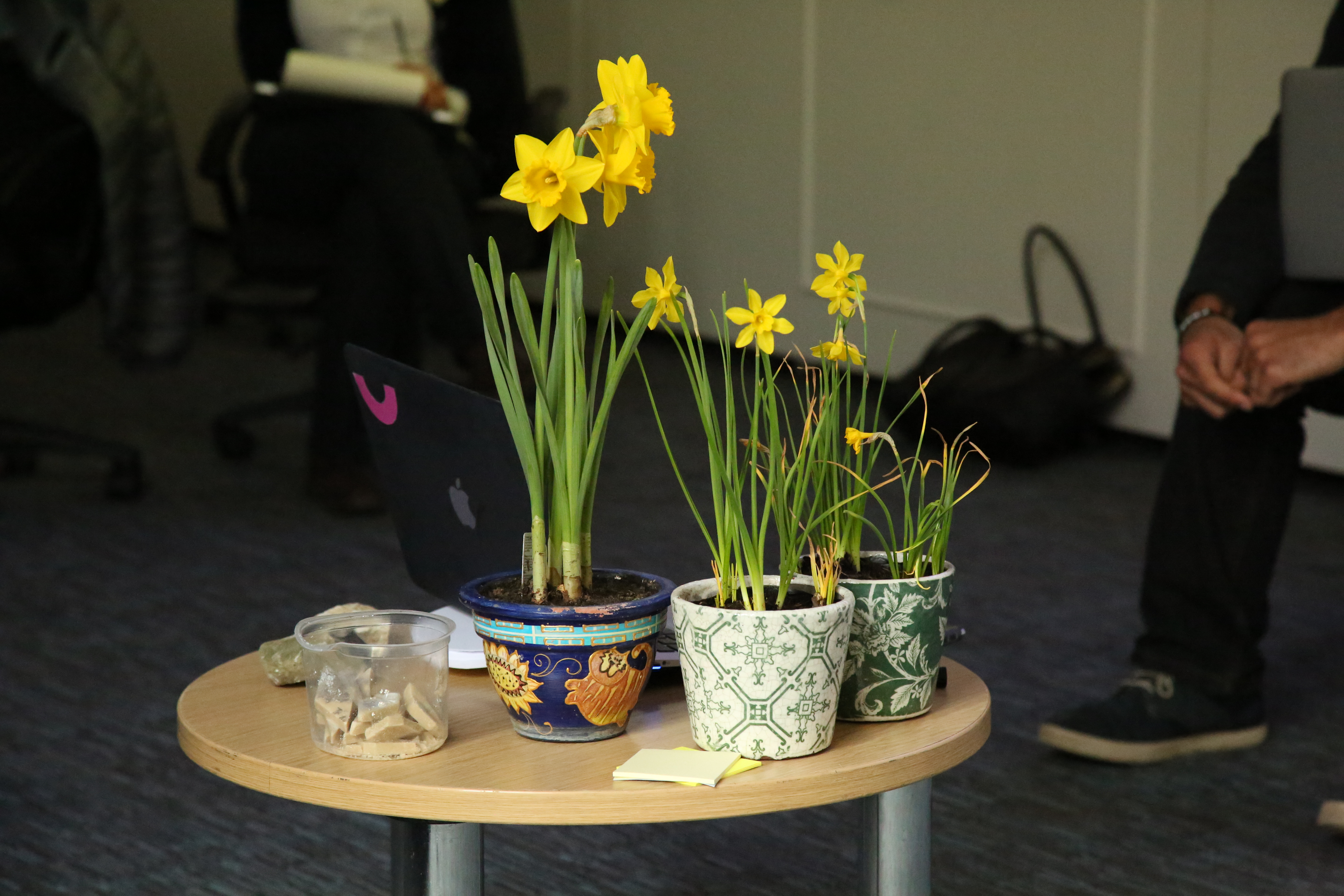
Daffodils, potted and blooming in April 2018 (photo credit: Shakti Satyapal)
In a world of climate change, species extinction and the loss of home for millions of refugees this seems like a time of great mourning. Loss and grief have always been facets of the human condition: the Greeks called it “Penthos”. I’ve been puzzling over the different ways to meaningfully express this familiar and yet enigmatic feeling in today’s world. Is it possible, for example, to mourn whilst also being hopeful and full of action? In this blog I look back over the past four years of my life, on the emerging history we are now living through and reflect on how proximity to others’ stories has helped me change my relationship with Penthos.
Our darkest grief has the bronze color of the moon eclipsed — Henry Thoreau
I stumbled across my diaries from December 2014 the other day and found the above quote from Henry Thoreau underlined. Leafing through I saw how much I was thinking and writing at that time about denial and grief. I’d been working in environmental sustainability for ten years by then and I was finding myself numbed by a sense of fruitlessness in my endeavours. I was exhausted by my work and psychically worn out by the false optimism of the environmental movement. Carbon emissions were still rising. Species continued to be lost. It became increasingly clear that I needed to acknowledge this in how I approached my work. Was it possible to renew myself and my activism from within the crucible of despair? Douglas Christie’s book “The Blue Sapphire of the Mind” offered the Greek word for the practice of grief “Penthos” as a way of facing up to our world. And back then my journals record how I found myself bathing in the warm comfort of this idea:
“After reading about Penthos I went on a quiet walk into the woods – a non eventful December Wednesday. The day started in muted fog – but it was light and there was that weak yellow sunshine behind it; the birds were resting in their solitude – I walked back into a foggy light and felt so abundant” (Journal entry, December 2014)
Aldo Leopold in the Sand County Almanac writes “We only grieve for what we know”. I wanted to ‘know’ my landscapes, past and present, inner and outer, and was ready to mourn for their passing:
“I have to accept there are fewer natural spaces. I remember the haycocks, smells and early summer in the rural landscape around where I grew up in the midlands of Ireland. The manure smelt earthy and foul. The field mushrooms grew unglamorously among the thistles and cowpats – though they tasted surprisingly good. ” (Journal entry, December 2014)
This wasn’t then a nostalgic mourning I was reaching for – more a kind of acknowledging. All this rumination suited the time and my mood. December light in the West country of the UK conveys a soft pathos that fits a pensive quality in my personality. I can know and inhabit those moments Robert Frost speaks of as “lovely, dark and deep”. As I stepped out each day, I wondered how I might enact some form of retreat into contemplation from within the busy reality of my life. I had two children of school age, was involved in my village community outside Bath and I had a busy research practice. I’d no wish to cut connections – but I had a strong impulse to simplify – and to flee from front-line action in the world. For too long now it felt like I’d had my thumb in the dam. Douglas Christie again helped me to frame withdrawal as entirely valid. He described how, during the fall of the Roman Empire, many men fled to the desert to contemplate. They became known as the Desert Fathers, establishing a contemplative tradition that took seriously the idea that:
“by healing and reconstituting the fragmented self, they were reknitting the torn fabric of being (p41)”.
So, their retreat to the caves and nooks of the desert was not a flight from crisis; it was a spiritual and societal response to it.
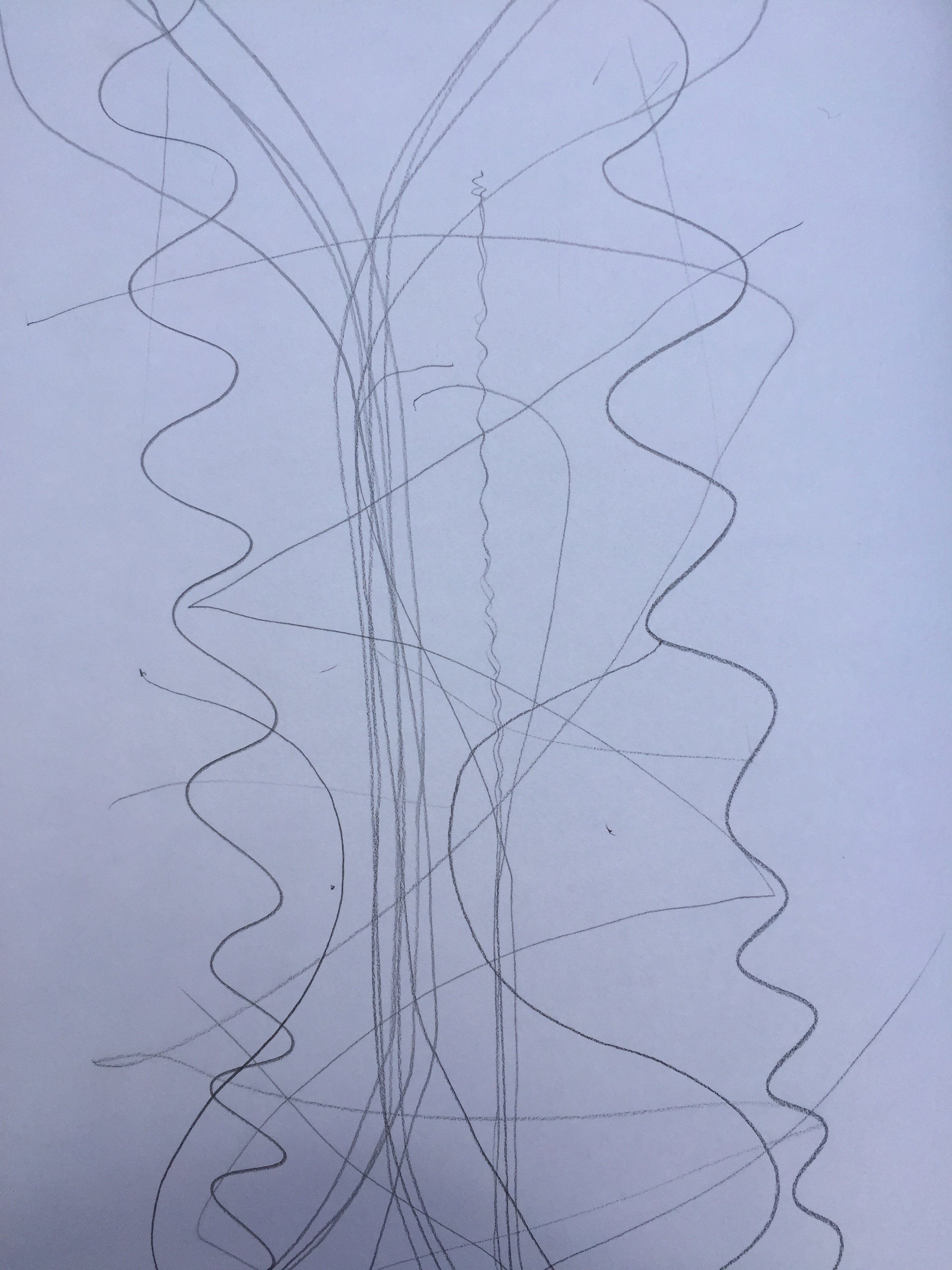
Sketching the ‘torn fabric of being’
“reknitting the torn fabric of being…”
I was entranced by the phrase: ‘the torn fabric of being’. I repeated it to myself hearing it each time afresh; I even tried to sketch it. It struck a deep chord. The retreat I was considering could be a political act. The symbolic cave would not only bring self-healing but would “reknit the torn fabric of the world”. How cool was that? So by the end of 2014 that’s roughly where I was heading – off to do some spiritual knitting.
Things didn’t quite work out that way. In fact the opposite happened. Far from the cave, events knitted my reluctant self into the cut and thrust of life. Soon after I became a tutor on the Masters in Sustainability and Responsibility, and set about intensively designing a new programme with colleagues against a backdrop of institutional change. And at home my teenagers were growing up fast – stretching and straining – noisily negotiating power, trust and love as they needed to. “The Buddha didn’t have kids or a job to do”, I thought ruefully – even a little enviously – longing still for the cave and some quiet concentrated Penthos. Life felt noisy.
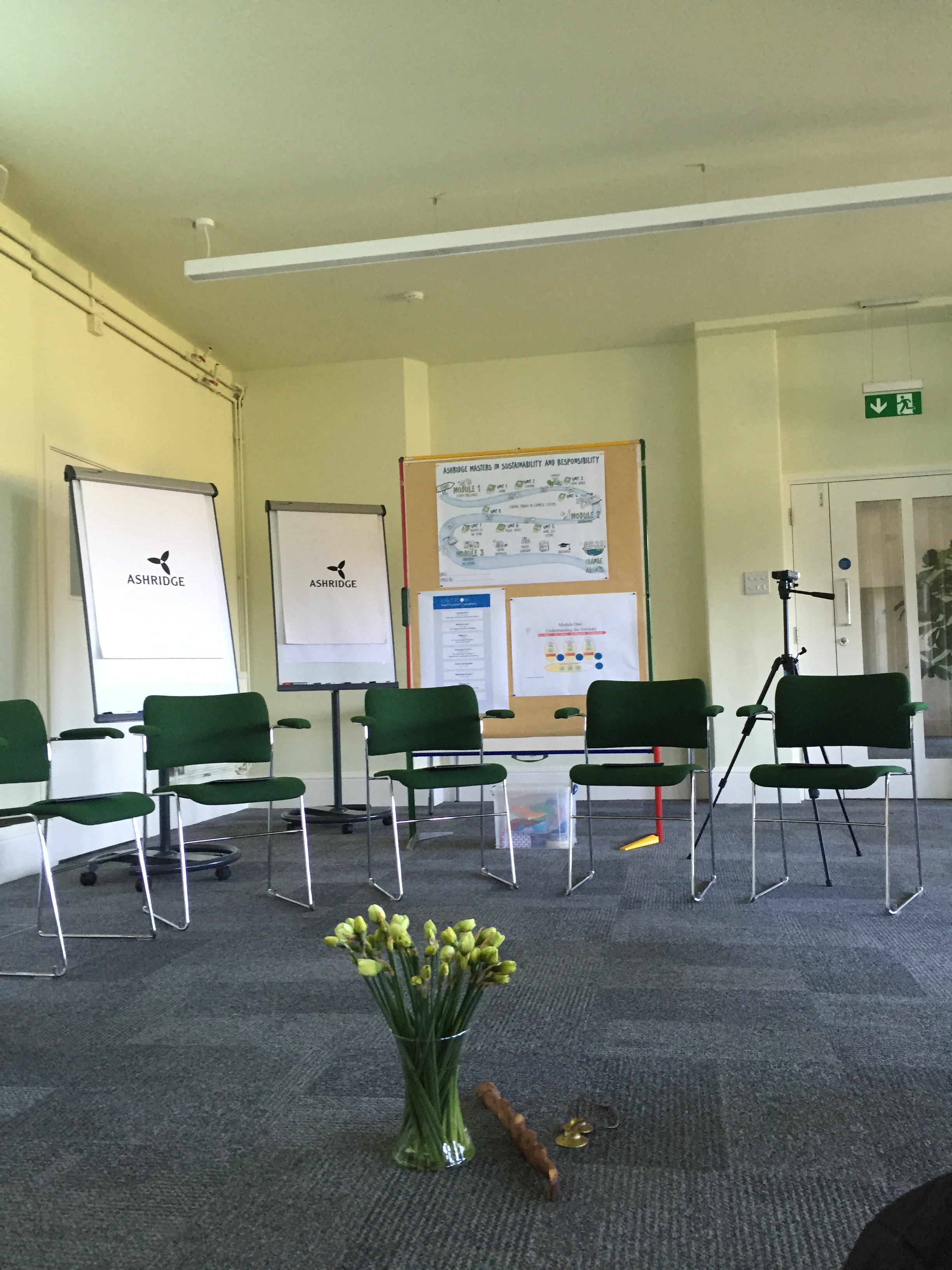
March 2016: Closed daffodils, moments before opening the Masters in Sustainability and Responsibility
Time marched on. In March 2016 the new Masters in Sustainability and Responsibility launched with 18 students from all over the globe – bringing together stories from places like Peru, Ghana, Saudi Arabia, South Africa and North America with British and European traditions. These were students who brought youth, wisdom and vigour to social and environmental causes and were motivated to change the world in ways I’d never even thought of. And the world itself was changing – politically and environmentally. We started our first workshop with questions of hope and climate denial, a vase of daffodils, gentle, placed in the centre of the room with buds tightly closed. They opened tentatively as our workshop wore on.
Looking back now to that workshop, I think: “little did we know it; those were the good times!” On the world stage a democratic, political commonsense seemed to be prevailing in the face of all the instability. The word VUCA (volatile, unstable, complex and ambigious) was coined and reassuringly applied as a description of ‘what was going on’ in the world ; the word itself had a comforting solidity – suggesting tameability. If we could only grasp what VUCA meant then surely we could carry on smoothly through it. And in my own life too it felt like things would meander along the same path forever. How could I have foreseen that a news headline from the scorching hot summer of July 2018 would read: “President Trump visits the UK during crumbling Brexit talks”? Or that the Masters programme was only to last 2 years before institutional changes meant it would be closed down. How could I have anticipated or even begun to fathom my Mother’s life-changing illness, and the loss of my beloved Aunt? Or the bittersweet path of my teens to adulthood?
I did not predict any of it – nor did I wish for it. And yet…..I’m not as miserable as I once was.
In April 2018 I sat with those self-same students in our closing workshop. We had daffodils again – this time potted and blooming. The students were now presenting the stories of their final projects. And as they spoke – one after the other – a rich tapestry was woven. One student described how by walking an ancient pathway she could find a guiding metaphor for her entrepreneurial sustainability work; another described how he’d gotten a healthy nutrition project off the ground with socially excluded groups in Lima. Over two days the stories kept coming. Stories of actions taken out in the world – some bold, some subtle – in oil companies, universities, communities and all kinds of organisations. Some told of exciting new initiatives and partnerships, and others told about those almost imperceptible moments of significance – in which the old way of doing things gave way to something new. Running underneath all this were the quieter stories; in the interior and exterior landscapes of the students. We heard of sketching late into the night on kitchen tables, of conversations with family that hadn’t been had before, of walks in the midnight snow in Copenhagen or under the majestic trees of the Canadian mountains. We heard of a weekend spent sweating and struggling to clear a woodland path in bitter winds before returning to ‘work’ on the Monday. And blessings to Gaia whispered into the wind in Switzerland. These and many stories kept coming – bringing a stillness, a tone to the action.
And as I listened it dawned on me there and then that these students were speaking from within the ‘torn fabric’ itself….they were knitting it in real-time. There was a unique quality of wholeheartedness that blended lively action with something altogether more heartfelt. Each student had their own version of ‘the cave’ – whether it was a vegetable garden, a sketchpad or the poetry of Dante. There was some sadness. And at times some tears were shed. The end of the programme was looming, yet I couldn’t find my way back to that feeling of Penthos that had seduced me so in 2014. Spring had come, fresh and inviting, filling me with love and gratitude. Somehow my proximity to these stories over the two year had accidentally woven me into feeling more wholehearted myself. I can’t say I’m any more hopeful. But Penthos suffuses me differently now – more like a mist than a dark cold pool in the core of my being. The quiet cave does still beckon me. And I think it always will. But now I see that being in the action – and right up close to the stories that are emerging – doesn’t have to mean forgetting about Penthos, it can just make it easier to wear.
This blog is dedicated to the tutors and students of the final cohort of the MSc in Sustainability and Responsibility at Ashridge/Hult business school. AMSR7 – you know who you are.