
Blog
Soft time (II): Staying with the future
Living in the Future Proche
What if the future was irresistible?
What if the future was so enticing you wanted to kiss it?
Since I wrote my last blog, the US and Israel attacked Iran and war has broken out in the Middle East. On the day I write this, the UN’s weather agency has reported [1] that the Earth’s climate is further out of balance than at any time in recorded history.
At a talk I attended in Bath last week, the veteran environmentalist Jonathon Porritt was asked to summarise the current situation on climate. His reply was disarmingly simple: “We won’t dwell on this – suffice it to say it’s very very very bad.” A silence followed and then a nervous laugh rang out from a corner of the audience.
In the light of current affairs, the question I posed in my last blog might seem inappropriate or, at best, whimsical.
What if the future was so enticing you wanted to kiss it?
Kiss it? If anything, we are living in the very future my 9-year old self imagined with such dread. These days I find myself shrinking from the news, not really wanting to extrapolate too far into the future.
I want to stay in the ‘future proche’ which I’m revising in my French class. Future proche is the nearby future and it’s tied to immediate action: ‘I am going to eat my lunch, I am going to call my friend Sylvia…I am going to read this essay’. Future proche is distinctly not the Future Simple as it’s called in French – a little misleadingly – to refer to something that will or might happen at some point. For example: ‘what will happen if the US and Iran can’t sustain a fragile ceasefire?’
There’s not so much worrisome imagining required with the Future proche, it’s more action planning, and for now that is as far into the future I want to go. At times like this, people often find themselves turning to questions of hope, as a way of safely engaging with the future.
“Are you hopeful?”
one audience member inevitably asked Jonathan Porritt last week, after we’d spent time with the enormity and discomfort of his ‘very very very bad’ situation. I wondered how many times, over his fifty years as a tireless climate advocate, has he had to find the right words – words that are honest – that won’t soothe away the discomfort, but that equally won’t open the door to despair.
It’s important, at times like this, not to pass through the door marked despair – just as it is important not to pass through the door marked ‘it’s all going to be fine’. We must instead stay in the dimly lit corridor of not knowing and find a way to act and live all the same.
Back in 2017, I exhorted myself to stay present and active in that same corridor when I wrote about hope ‘as an act of defiance, as a choice, as a politics’ (see blog here). At the time I was still grappling with my sadness about Brexit and the election of Donald Trump. Rebecca Solnit’s Hope in the Dark [2] helped me find a place to stand.
I continue to be inspired by Rebecca Solnit. Her recent writing suggests we are living through a slow revolution as an old global order dies and something new is being born. To appreciate these longer arcs of change we must let histories – past and future – suffuse our perpetual presents [3].
It’s strange to return to my earlier blog eight years on, to renew my vow as it were to sustain ‘hope in the dark’ and to notice how time has marched on. “Those were the good times” I find myself saying, not in a triumphant know-it-all way – but more with the rueful realisation that maybe today’s days might turn out to be the good times too.
Because in a way these are good times. This returns me then to that dimly lit corridor of not knowing and the question from the last blog. I return to ask it again – this time with even more seriousness.
What if (despite all this) the future was (still) irresistible?
What if the future was so enticing you wanted to kiss it?
These now become provocative questions. They galvanise me, even, to stay in that darkened corridor and question all the doors that say ‘this is how it plays out’.
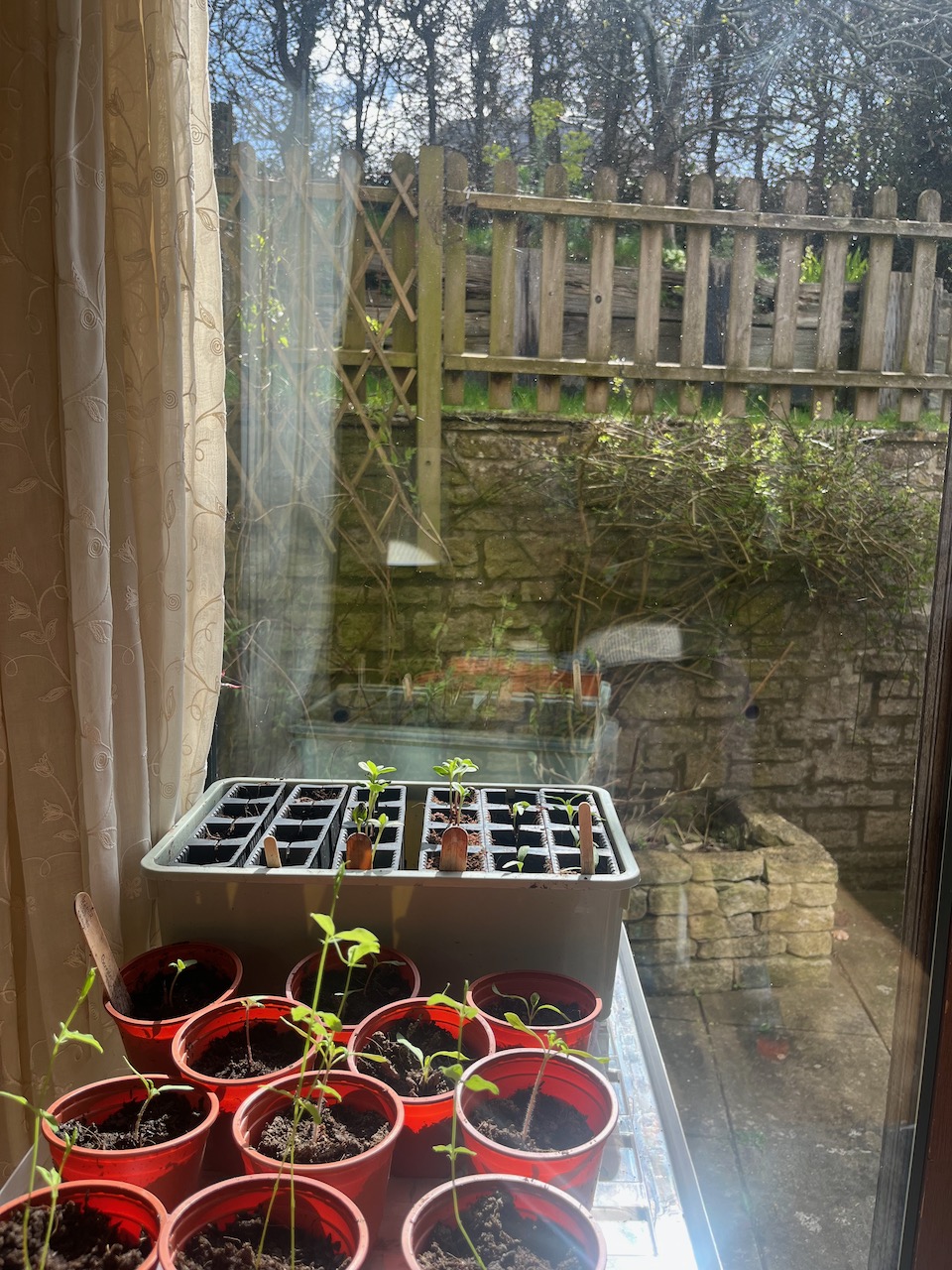
In truth I don’t mind the Future proche, I could kiss the fact that later today I’ll meet a good friend and have coffee with her, or that I might pot on my tomato seedlings. I could kiss each one, and I could kiss the cool March air that graced my bare arms this morning running along Warleigh Lane.
Can I kiss the ungraspable “Simple Future” – the collapse, the wars, the devastation that may be coming? No, but as I say that, I realise that this future is already here. It has been here for some time.
All this zooming back and forth seems to relate to this idea of ‘soft time’ that I began to explore in my last blog. There, while sitting on a stone wall, I sensed that any present moment is not part of a chronological sequence of past, present and future neatly laid out.
Now, regarding the politics of today, the poetry of the moment is more confronting. The feared future is already here. The imagined past is still alive. This present day is what Donna Haraway might call a ‘thick present’ because it’s got past and future in it – it is alive with multiple temporalities all folded in on each other.
What then is an ethical way to live through the moments of these days? How can I stay engaged in the here and now of what is playing out?
My friend Jean who I met for coffee is a wise woman. We talked about people we knew who were ill and how – at the end of a life – so much falls away. We talked about how, in that future that awaits us all, what starts to matter is a kind of honest witnessing and harmony. Jean has also written a recent blog on the ‘art of just right’ and on finding balance and integrity in these complex times – which feels connected here [4].
Perhaps it does come down to living in the Future proche – and allowing a kind of gentle quality to suffuse it. Asking for example, can I live each day with some kindness? Can I not shrink away, but lean into life and all that’s happening in the world with tenderness? Can I find time each day to rest into beauty?
Wendell Berry’s poem comes to mind and by way of closing I share it here in full:
The Peace of Wild Things by Wendell Berry.
When despair for the world grows in me
and I wake in the night at the least sound
in fear of what my life and my children’s lives may be,
I go and lie down where the wood drake
rests in his beauty on the water, and the great heron feeds.
I come into the peace of wild things
who do not tax their lives with forethought
of grief. I come into the presence of still water.
And I feel above me the day-blind stars
waiting with their light. For a time
I rest in the grace of the world, and am free.
Maybe this is a way I can still reach out and kiss the future.
Endnotes
[1] BBC News. “Earth’s climate further out of balance than at any time in recorded history.” (23/3/2026). https://www.bbc.co.uk/news/articles/c203rdxkezwo
[2] Solnit, R. (2004). Hope in the dark: Untold histories, wild possibilities. Nation Books.
[3] Rebecca Solnit, “A slow revolution the far right cannot tolerate”, The Guardian, (25/3/2026) https://www.theguardian.com/books/2026/mar/25/rebecca-solnit-slow-revolution-far-right-cannot-tolerate
[4] Jean Boulton https://www.embracingcomplexity.com/blog/
Share and Subscribe
Thank you for reading this and any other blogs! Please do share on social media using buttons below or click on the subscribe button here to hear about future postings.