
Blog
Notes from isolation – utterances
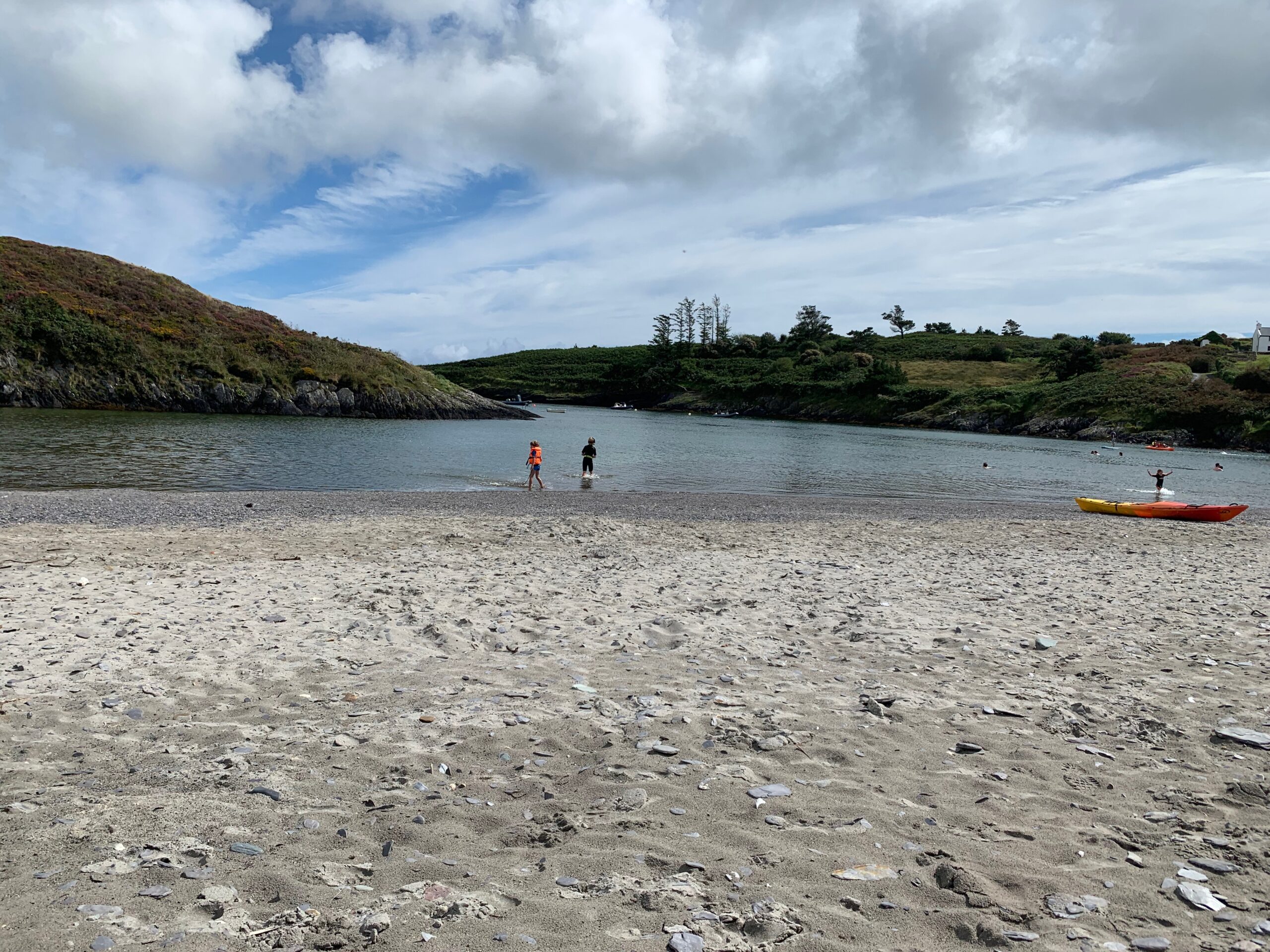
Beach near Skibbereen, County Cork
Into the sea
The desultory chalk sky has started to fluff and come to life. We change quickly sitting on the pier that runs out into the sea, our legs dangling, feet touching the sand. It is a small perfectly formed cove created by a stone wall, the pier and a bohereen[1] on the right. There is a neat bundle of clothes – a pink T-shirt and sandals on the wall nearby. I eye it to confirm: yes, it’s the necessary two metres away. The sky is warming.
Exclamations!
We wade in. No crossed shivering arms today. I pace in steadily until I am chest deep and then that moment of ‘getting wet’– down into the water – vocalizing as I do. Whoooh! Ah! Ooooh, it’s cold! I can’t stop myself from yelping like this – every time. Like it’s a brand new experience. I breastroke quickly until I slow and settle in the water. Shaped by it, accepting its new containment.
Self-conscious isolation
We are in West Cork staying on the tiny peninsula island of Inishbeg, tucked away off the road to Baltimore. Across a humpback bridge and at the end of a stone track there is a moist Irish rain forest that sits in the Ilen river estuary surrounded by sea or mudflats depending on the tides. Its own world. Some locals don’t even know it is there.
It’s a perfect place to self-isolate – to do time before heading out with the freedom of the country to see family again. My partner A. & I have been discreet in our restricted movements – conscious of the distinctive yellow of our UK number plate. There are just a smattering of us here – Anglo-Irish families presumably – parked away from the crowds in beach car-parks.
Enforced retreat – sitting
Make a place to sit down.
Sit down. Be quiet.
Wendell Berry starts his poem: “How to be a poet – to remind myself” this way and it is exactly what we have been doing during our enforced retreat (2). Before breakfast each day, we walk out on the paths of the island. We find a place to sit down and to be quiet for a while. Things do happen. The poetry of the estuary speaks. I wonder what words are adequate to this experience? There are nature writers I’ve read who have that descriptive skill – through their words you can almost hear the batting of a bird’s wing and see the texture of the sky. Yet even their eloquent descriptions haven’t conjured for me the experience of ‘sitting by the estuary’ each morning. It is of itself.
What to say?
The job of the phenomenologist said Edmund Husserl is to “see what stands before our eyes, to distinguish, to describe” (1). Husserl’s work released a whole generation of philosophers from the imprisonment of determining reality, by evading the question of reality altogether. The question is not ‘is it real’, but how does any phenomenon present itself to my experience. This requires discipline, he said, a constant bracketing off, or more lyrically an “epoché” free of pre-determined ideas and stories. To bracket is to shrug off your conceptual baggage and avoid cliché.
Glimpses from my experience
But what is the phenomenon to be distinguished and described I wonder as I grapple for words. I realize it is not my aim to describe the ‘sitting by the estuary’ in order to give you a feeling of what it was like – to bring you there by evoking the heron wading in the shallows or to help you see how the river thrusts inland, even when the tide is going out, sending out geometric lines to shore. Or to evoke for you those morose black and white cows staring from an upper field on the opposite shore. Where to even start with those?!
Pushing the brackets out
No, my aim is to couple these glimpses from, ‘sitting by the estuary’ with the experience that goes around it. Pushing the brackets out from the estuary experience, you can see us on the half-empty ferry, traveling as though on private yacht from Fishguard to Rosslare wearing surgical masks. The road travels back to our house near Bath where, with our adult children, we adapted to Covid-19 as best we could. Feeling lucky in our circumstances and uneasy at the shifts and changes we sensed but could not quite feel.
What utterances are worth making?
What is worth saying? What has to be said? What can be uttered from all this? Here, at last, my poetic activism questions start to flow again. They are questions of discernment. What utterances (rather than descriptions) help me (us) live in, and be with, the current phenomeon as it presents itself?
Lost for words
The truth is, that for months, I have not wanted to say anything at all. There has been so much loss: of life, of health, of equanimity and of livelihood for so many (3)(4)(5). I guess, like those of us who feel fortunate, I have been experiencing and grappling with both the monotony of my days and the entropy around them – the torn paradoxes of Covid-19. The sense of tragic loss and consequence and adaptation that is just out of sight of the stilled and simplified locked down days. The drama has felt political and existential – and yet life has felt curiously normal. In the absence of easy words of description – I’ve chosen not to say anything at all.
A big enough story to speak of – discerning ‘that’
What is a big enough story to live in? This is a question I’ve taken from Ursula le Guin and talked about in earlier blogs (here). If Husserl bracketed things in, I ask here about pushing the brackets out – extending out the story until it is big enough to matter – to really matter. To keep going out until I can discern the ‘that’ – the phenomenon I need to talk about. It’s the estuary, the coming to the estuary and the difficulty in finding the right words. This is what I must utter.
A tentative utterance
So this is my tentative utterance from that place. It’s in tune with the poetic spirit of Wendell Berry who urges us to seek words that don’t disrupt the underlying silence of the experience itself.
Accept what comes from silence.
Make the best you can of it.
Of the little words that come
out of the silence, like prayers
prayed back to the one who prays,
make a poem that does not disturb
the silence from which it came.
How to be a poet, verse 3, Wendell Berry
It is with Berry’s gentle reminder in mind that I come back to words on this blog. I know that utterances from the poetic activist cannot always be so soft or nuanced; some things must be said more loudly – to be exclaimed or yelped out. But quieter utterances is where I start and for now this will do.
Poetic Activist – questions to chew over
(1) What experiences or phenomena are presenting themselves to you that are worth speaking about? What is a big enough story around these experiences? What words or utterances might you use that will do justice to these experiences?
(2) What experiences or phenomena present themselves to you that you cannot help but say something about? What words or utterances might you use for these and to whom might you say them?
Poetic Activist – micro-discipline
Repeat for three days or more.
Find a place to sit down.
Sit down.
Set a timer.
Be still.
Allow yourself to notice what you notice, in you, around you.
Jot down or share with someone what you noticed.
Notice the differences each day.
Notice what from this experience you feel like speaking about over the next days.
Notes:
(1) Remarks about Husserl and phenomenology are from a reading of Sarah Bakewell’s entertaining and accessible storying of existential philosophy.
Sarah Bakewell (2016), At the existentialist café – freedom, being and apricot cocktails. London: Penguin, Random House Press.
(2) For the full Wendell Berry poem see https://www.poetryfoundation.org/poetrymagazine/poems/41087/how-to-be-a-poet
(3) Maria Popova on www.brainpickings.org writes extensively on stillness and writing and speaking from a poetic place. A good exploration of Wendell Berry’s poem and onto a poem on stillness by Pablo Neruda can be found here:
(4) UK deaths from Coronavirus – 41,381 by 19 August 2020. (Source WorldOdometers https://www.worldometers.info/coronavirus/country/uk/)
(5) Depression in British adults is reported to have doubled during the Coronavirus crisis https://www.theguardian.com/society/2020/aug/18/depression-in-british-adults-doubles-during-coronavirus-crisis
(6) 75,000 were reported to have lost their jobs in the UK due to the pandemic by August 11th, 2020 https://www.ft.com/content/c8ef84bf-0539-4281-b353-d5b840d10b5e
[1] A small road – from the Irish for road “bothair”