
Blog
The slow train to Rome – searching for a new story
Disenchanted and stumped by Brexit I decided to leave the UK over the much heralded Halloween deadline of October 31st. This blog is part travelogue and part meditation on the recurrent themes of everyday activism that continue to fascinate me. As the train trundles on, I reflect on what meaning did this trip hold? Was it a minor act of anarchy, a meditation on the travel habits of cats and dogs or something else altogether?
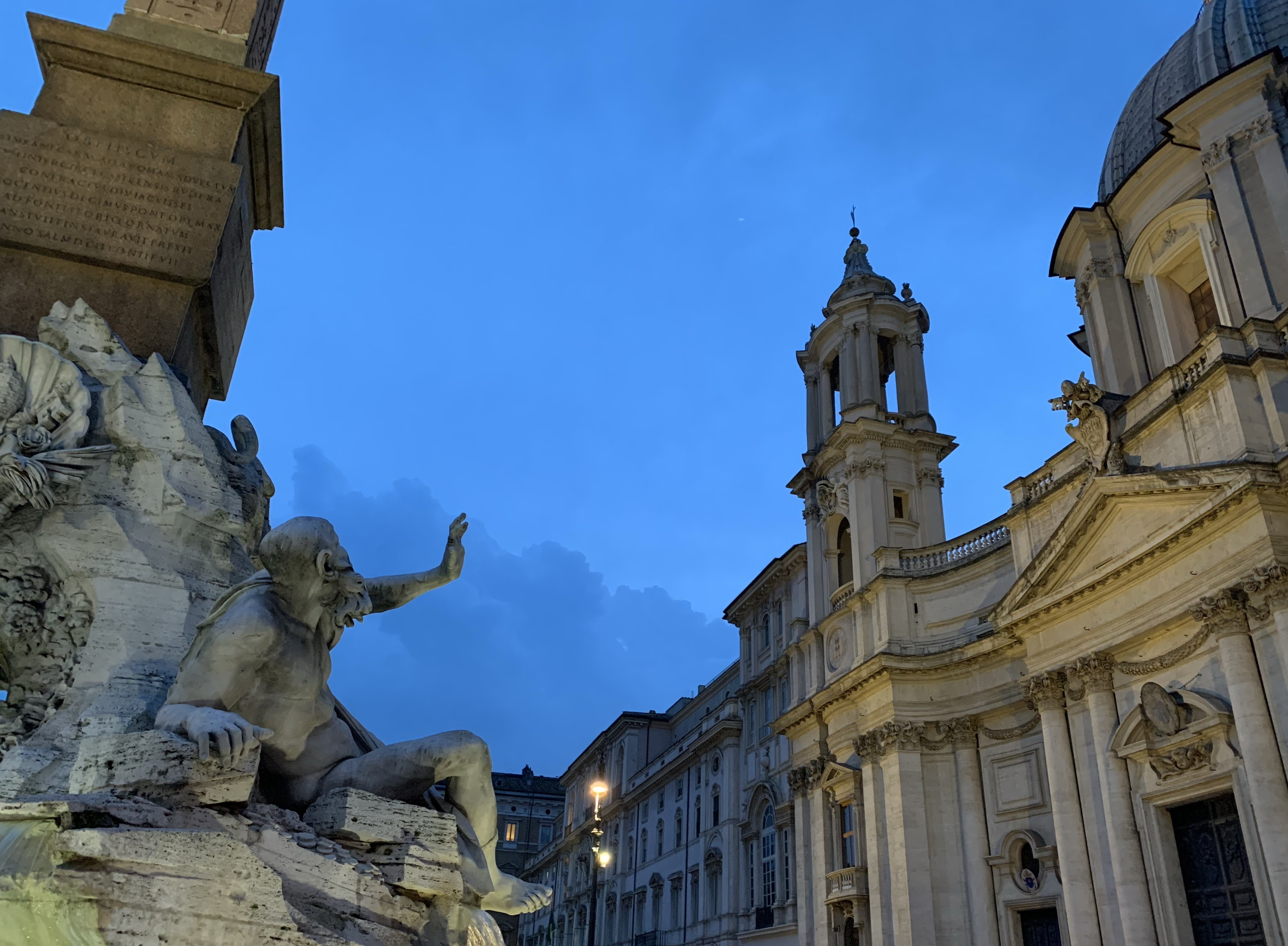
Four rivers fountain: Rome
Protest travel
“What on earth do you want to do that for?” asked my friend R. I’d told her that over Halloween I would be taking the train to Rome. Well actually I would be taking seven trains to Rome – and the journey would take two days and cost three times as much as flying. I’d spent an entire weekend in October stitching the itinerary together with the aid of the congenial and well informed train-guru: “The man in Seat 61”. It’s true that the maths were all multiplying. But this wasn’t about the maths. “I’ve just had it with Brexit”, I said, “I don’t want to be here on the 31st whatever happens”.
The idea started as a desperate gesture – which had its genesis in my last blog. I wanted to exit from Brexit. Boris Johnson’s insistent refrain that the UK would be leaving the EU on the 31st of October had got to me. I felt powerless and disenchanted, like a child being told it’s bedtime whether you like it or not. So I decided to travel eastwards and in contraflow – across the channel and visit as many European countries as I could. I wanted to find a different way to protest. This journey was to be my response – a love song to Europe.
Setting out
My partner A. and I looked conspicuous with our brightly coloured rucksacks as we joined the weary commuters leaving Bath on the 6:13am train. On the Eurostar the business-like hush and murmuring continued. I pulled out David Graeber’s tiny book: “Fragments of an anarchist anthropology” which we’d settled on the week before in my bookclub. Graeber is an anthropologist and self-proclaimed anarchist who was influential in the Occupy movement. Not only is he a well-respected academic, but he’s an accessible, delightful writer – drawing on his extensive experiences as an anthropologist in Highland Madagascar to animate his arguments.
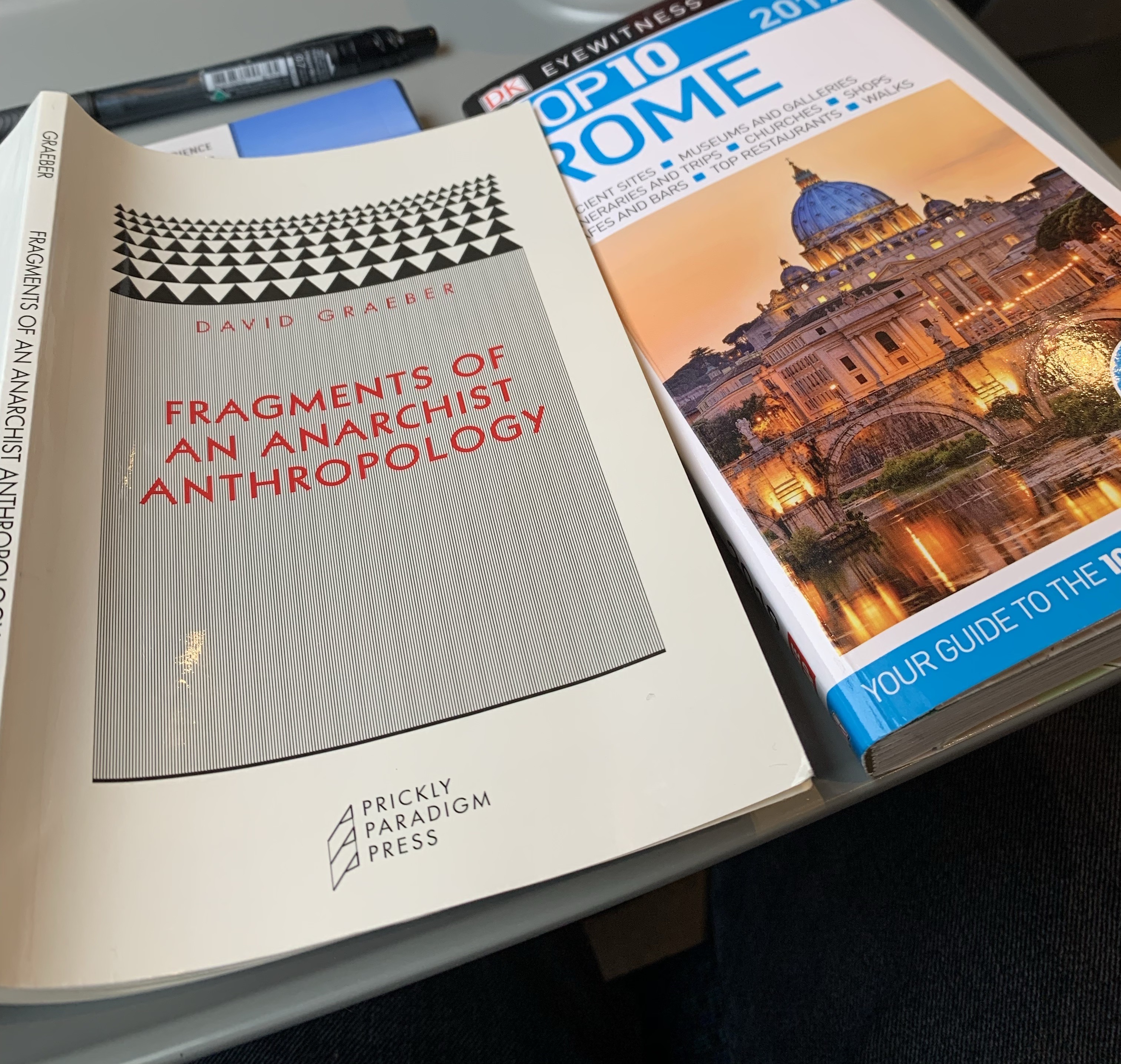
Reading on the Eurostar
Anarchy: don’t protest, dig your own well
Anarchy, says Graeber, is all about acting as ‘if’ you are free, without rules or acknowledgement of the structures that hold you. Protest itself is a problematic concept to Graeber because with protest you are adopting fixed positions: “It still becomes like the Foucauldian disciplinary game where both sides sort of constitute each other” [1] he eloquently explains illustrating it thus: imagine a city where the water supply is limited due to the Mayor being in cahoots with the commercial water company. If the towns-folk protest outside the city hall, they still acknowledge the status quo of where power lies; whereas if the they go out and dig their own well – that’s direct action. “Ah, I get it”, I thought. Up until now I’d been faintly afraid of the word anarchy. Now I realized I have an affinity with it. I’ve often felt uneasy with protests that rely on or ask government to do something that they clearly won’t do. The Revoke Article50 online petition is a great example. I signed it but the subsequent damp squib of debate in Parliament where it was ruled out – seemed only to consolidate a sense of powerlessness. “I wonder what Graeber thinks about Extinction Rebellion and their forms of action and demand ”, I thought and I looked out the window. But I could only see black. We had entered the channel tunnel so were now several leagues below the sea.
Bonjour la France
I felt a momentary thrill when the windows lightened and the train emerged in France. Most societies are to some extent at war with themselves went on Graeber describing how counter-power always will exist in society:
“The most egalitarian, peaceful societies that are often the most haunted by constant specters of perennial war. The invisible worlds surrounding them are literally battlegrounds. It’s as if the endless labour of achieving consensus masks a constant inner violence”
(David Graeber, P24 from “Fragments of an anarchist anthropology”)
Wow. This was a whole new way to see Brexit. I read it out to A. who nodded amiably but didn’t seem as impressed as me.
Paris: a feline protest
At Gare de Lyon we stopped for lunch and a café-crème in one of those typical French brasseries with efficient waiters and red leather banquettes. All around us were people with large cases grabbing a bite before traveling onwards. At the foot of the table next to us a cat in a large carrier basket miaowed loudly throughout drawing looks from other diners. A feline protest of what was to come.
On the Paris – Geneva train we settled into our places. A woman boarded with a small dog in her handbag. A family group ate snacks and played cards at the table opposite. An older man with a lined, weatherbeaten face sat directly opposite and stared impassively at us – occasionally taking calls on his mobile phone and speaking in a language I didn’t recognise. As the French countryside opened out to wide rolling fields I put my book away and looked at the sky.
Geneva: specks in time
Next day the 7:36am train left Geneva uncharacteristically late and an apologetic train guard passed through the carriage with free vouchers for coffee. We would be late for the connection to Rome in Milan. Though I’m normally obsessive about time-keeping it seemed of curiously little consequence. As the bright blue and pink graffitti’ed sidewalls of suburban Geneva gave way to terraced vineyards and finally the expanse of the Lake itself, the patchwork of human industry was woven all around us. Our journey was just a mere speck inside it all. We flashed by commuters standing on platforms with builders on pulleys and cranes behind them. And now here was a heron standing on a rock by the water – intent and still.
Hey what is it with you British guys?
By the time we were on the train to Rome, I’d stopped thinking altogether and reading was out of the question. There was a buzz of excitement building up on the train. A. and I were squashed at a table of four. There was a nun in mufti diagonally opposite and after a while the elegant Milanese man beside me struck up conversation with us. Hearing we were from the UK he asked the inevitable question: ”Hey – what is going on with you guys – with thees Brexit!?” “Well it’s why we’re here”, I explained, “we wanted to get away for a while – you do know half the country are against it?”. He neither seemed to know nor to be too interested in that. Instead he explained why Brexit was such a bad idea. I listened and stared down the carriage. Yes. There was another dog – a small dachshund standing quietly and unperturbed.

A passenger on the Rome train
Making meaning
In the event, the UK did not leave the EU on the 31st of October. So in one way this trip was little more than a holiday. What, if anything did it mean? It was a minor statement I suppose. It felt good not to fly, and the small story I told myself about this being an act of resistance to Brexit had gathered meaning with each passing mile. Reading Graeber, I could even say it was a minor act of anarchy. It wasn’t a protest, so much as a way to win back freedom in telling my own story. This kind of action doesn’t require courage or struggle though I guess it does need imagination and conviction to sustain it. And as the train trundled on there had been unexpected bonuses. I found I had space to decompress and get a fresh perspective and notice new things.
Coming home
When I arrived back in London there wasn’t a cat or a dog to be seen. I found myself stopping to stare in wonder at the curved iron roof in St Pancras. Later when all our trains were cancelled out of Paddington, we laughed with two stoic commuters opposite us on the slow train out of Waterloo, as they drank G&Ts from a can and chatted about their kids, football and living in Bristol. I was glad to be home, I realised, and a small feeling of joy unfurled in me. In that moment Brexit didn’t seem to matter any more. I felt enchanted again and a little bit proud to live here. Well who’d have thought my journey would bring me here.
Footnotes
[1] http://www.thewhitereview.org/feature/interview-with-david-graeber/
Related: check out Steve Marshall’s blog ‘Communion’ which features a beautiful image and words about the importance of not being in a hurry.
Calling fellow travellers!!
Have you a story to tell about your responses or everyday activisms?
Those of you who have read this blog for a while now will know that I grapple with the question of my activism in the face of issues I care deeply about: most specifically the current climate crisis, and the ecological crisis. I know I’m not a ‘take to the streets’ type of activist and have puzzled over what quieter types of activism might be grown out of our everyday lives. On these matters, however grave, I had been finding a place to stand and things to say. I advocate a poetic kind of activism – to seek out small acts of courage, beauty or disobedience that arise within the contours of my life. I actively seek out kinship too – for this idea – as well as connection with others who hold similar questions and have their own stories to tell. All this has been going on and I hope to write more about it.
Do you have similar thoughts? Do you have stories to tell of your own responses or actions that connect in some way with what I’m writing about. Would you be interested in a guest blog spot or sending me a short story? If so, please get in touch by mailing me at info@newhistories.co.uk.