
Digital stories
The following digital stories were created in collaboration with Storyworks at the University of Glamorgan and the University of Bath as part of a pro-environmental behaviour change research project we developed for the UK governments department for the environment, farming and rural affairs: DEFRA. The final report is available in the publications area.
Narrative Coaching public sector executives against a backdrop of major organisational change
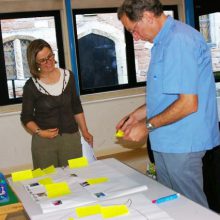

Narrative Coaching public sector executives against a backdrop of major organisational change
Over 1 year I worked with the board of a large public sector organisation. Times were hard. The organisation was going through a major re-structure and the top team needed to point towards a hopeful new vision for the future whilst acknowledging the deep uncertainty most people felt. In 1:1 narrative coaching sessions I sat with directors to help them develop the skills, and often the courage, to tell real stories to go alongside their dryer (and often) necessary strategic powerpoint slides and all-points-bulletins. In session, using images, writing exercises and story practices I supported each leader to experiment and find their way to a narrative style that worked for them. As we worked, we also reflected on their leadership and the stories that inspired them personally. At the end of each session these busy execs went away equipped with tools to try out, and crucially, ready to listen differently, noticing potential stories coming up around them. All commented on the value of the sessions in giving them the space to not only talk things through but to go away with real actions to try out. Each director applied the skills in different way. One reported how he now using storytelling impromptu in his team meetings had completely changed the motivation in his team. Another board member was a passionate photographer and resolved to introduce his own photos into all-staff presentations to bring himself into the message he was sharing. Collectively, over the sessions an awareness started to build up of the different strengths and styles they had as a board. The next phase envisaged was to work at the team level to explore the story they told together as a team. However at just this point the board itself was re-structured and so the narrative coaching came to a close.
Learning as we go – Capturing the learning from a ‘golden team’
Learning as we go – Capturing the learning from a ‘golden team’
In 2010 I met with deputy chief exec of a large public sector organisation. “We have a few ‘breakthrough’ teams who really seem to demonstrate that can-do, performing way of working for the future”, she said. “We want to better understand what’s going on in those teams”. A learning history seemed ideal. Together we devised a process whereby I would work alongside a particular team that was making impressive strides bringing a new technology to the organisation. The project was still going on – so we agreed I’d need a light-touch, supportive approach – something that would boost and strengthen the team’s learning. At a first workshop I helped the team map out the key moments and events of the project so far. The team immediately remarked how valuable this was – how little time they had normally just to reflect together. In short 1:1 dialogues I then worked with them individually, hearing their story, reflecting with them on the highs and lows. The challenges they faced.
Gradually these different interweaving voices started to build a picture of where we could begin to see how the success of the team lay in the way their different skills meshed in a complex and subtle way. This was an interesting learning history project as it was not based in the past but the present. Learning was being ploughed straight back into the project. By giving them space participants could think in real-time about challenges they faced. Based on this I captured a ‘learning history’ account and then convened a number of learning events in the wider organisation. In these events members from the organisation reflected on the story presented and on the ‘secret sauce’ of this project team – making connections to their own projects and teams. Interestingly the project was ultimately not successful in the conventional sense. The innovative new technology was not introduced. However the learning history had highlighted a different kind of entrepreneurial quality at play in the project team that was less about success and more about a new way of working.
Spreading learning from green community activist groups across the UK
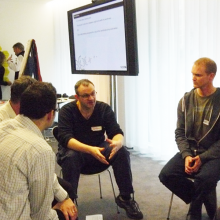
Spreading learning from green community activist groups across the UK
In 2009 several communities from across the UK participated in NESTA’s big green challenge competition which sought to award a £1M prize for the most innovative green community project. Recognising the broader learning opportunity the finalists were then invited to participate in the big green diffusion project – an action research series of learning workshops that were co-designed and delivered with NESTA and my colleague Gill Coleman at the centre for action research at Bath at that time. In these workshops we brought these community groups together with related agencies to explore how they might share and spread their learning more widely. Participants presented their projects, sought links between them. They explored different ways diffusion and widespread change might happen. They sat in storycircles and told stories and then drew out common themes from those stories. And they talked about climate change and environmental issues. And the impact this big issue had on their thoughts and emotions. Over the workshops they built a picture of how diffusion might happen. But as importantly they shared a learning environment together, got some space to think and made links that then led on to new collaborative ventures being developed. This was an interesting project because it had an explicit research question which was to do with the spread of learning. What we found was the learning in the room was a very real expression of an answer to that question.