
Blog
Minor acts of courage and disobedience
What is the everyday activism I’m trying to let emerge in me? What minor acts of courage and disobedience might such an activism call for? These are the questions at the heart of this blog, as I reflect on a day listening to creative, bold and imaginative stories of arts-based activism at Bath SPA University last week.
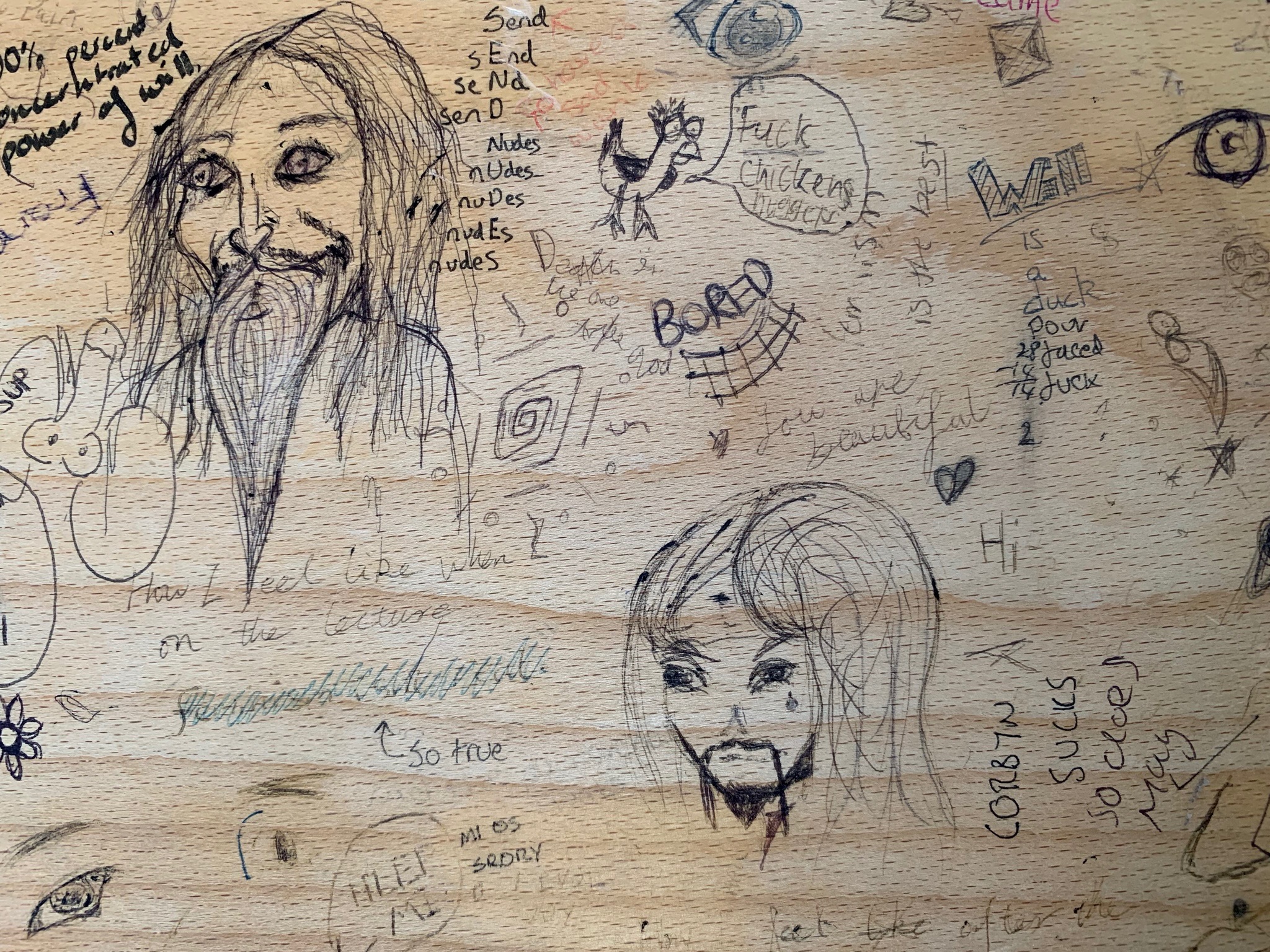
Photo: Desk graffiti on one of the desks at the symposium – a quiet protest
Boredom etched in memorium
Last Monday I took my seat in a crowded room on the first floor of Bath Spa University. I felt nostalgic as I reached down and pulled over the small wooden desk table and put my notepad onto it. When was the last time I’d sat in a seat like this? The words: “Kill me now” were etched neatly in blue biro onto the wood and made me smile. No doubt a timeless plea from a bored student – and one I could relate to. I can tap quite readily into the quiet desperation of a lecture hall: where the speaker speaks, and the audience listens. From years of mass attendance as a child I’ve mastered the art of daydreaming whilst seeming to also listen. The type of listening where you allow the message to ‘go in one ear out the other’ is a much-maligned and under-rated skill. I like to think of it as a sometimes necessary and silent act of resistance – to hold and protect your imagination in some way. To doodle, etch and puzzle away in response to the situation at hand. To attenuate your outer ear.
Hiding in plain sight – being visible and invisible
As it stood, my ears were wide open and curious this morning. This was a symposium titled “An uncertain forecast – art in the age of the antropocene and ecocide” and the topic of the day was all about resistance and imagination: the role of art as it relates to activism and environmental and climate justice issues. The line-up of speakers included the likes of activist Robbie Gillett, proponent of Brandalism– a revolt led by a group of artists against the corporate control of culture and space. “The high-vis jacket”, Robbie would say in his talk, “acts like an invisibility cloak”, as he described how his fellow activists, armed with said jackets and simple tool kits hijacked bus-stop advertising spaces and billboards to replace mainstream ads with ironic, hard-hitting alternative messages.
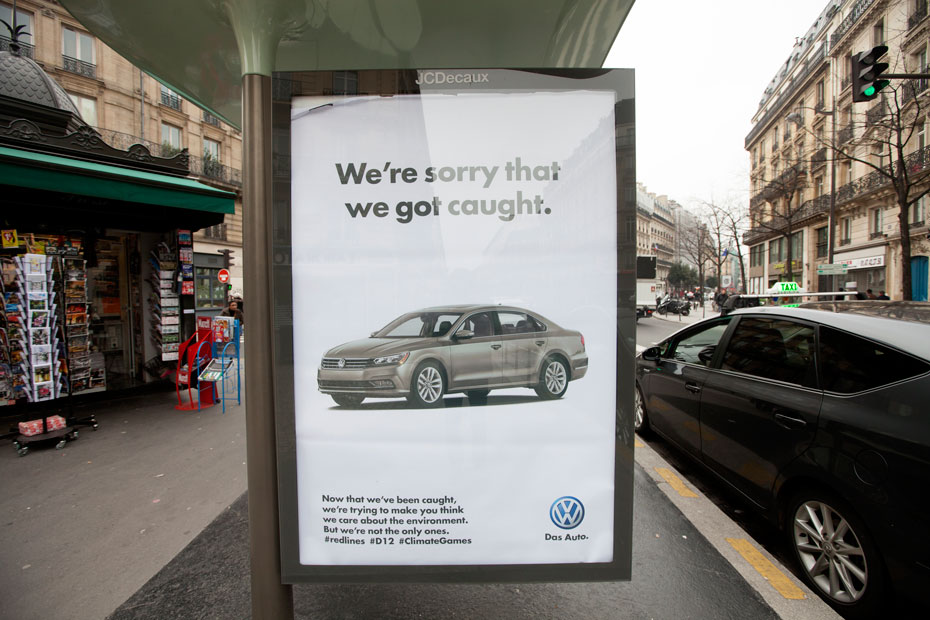
Photo: an act of Brandalism involves hijacking advertising spaces (downloaded from http://brandalism.ch/gallery/ on 19.06.19).
Robbie passed around little kits for hacking into bus-stop billboard spaces and as I turned the simple metal key over in my hand, I wondered: what would it be like to be this kind of activist? I longed in a way to be the person who pops on the high-vis jacket and does their disobedience in plain daylight. But it’s not me. What’s the subversive equivalent – what’s my activism I wondered. “Kill me now” winked back up at me from the desk, the message now sounding bored and nonchalant.
The event was slow to start that morning and as I looked round I could see the room was a mixture of students and age groups. I sat between two men of about my age – both studiously scrutinizing the day’s programme – but in the rows ahead were younger arty type students. Directly in front of me a young guy was dressed in full colourful combat-type gear including a check cloth that covered his face, held in place by a black insect-eye type ski-mask. He was a bit startling and when he’d taken his seat, the women either side had edged a bit away. But now I saw he was chatting away to one of them. I wondered momentarily about his story. Why did he dress like that? What did it ask of him to move so inscrutably through the world? Did it take courage each day? Was he hiding or showing up? Fleetingly, I imagined tapping him on the shoulder to ask- should I? No. In that moment he seemed unapproachable-or maybe I just lacked the courage.
Acts of courage and disobedience
I’ve been thinking a good bit about minor acts of courage and disobedience recently. Often I find myself in situations where I am uneasy at something someone says or does – but I stay quiet. Later I might declare to a friend or kin that I was ‘rendered speechless’, knowing this is a gloss on the truth. Because sometimes I do speak up – but choosing to do so takes energy and conviction. I can end up wondering if it’s worth it. Like the time I complained about casual sexism I saw at my local hairdressers. After my complaint, I spent weeks e-mailing, negotiating and engaging with the management team. “I only wanted a haircut”, I said exasperated at one point to the managing partner who was trying to make my complaint disappear, ‘but I couldn’t let this go”.
Responsible activism – “working within your anarchy”
Courage was not in short supply during the talks that morning. Neither was imagination. “We saw those Royal Bank of Scotland AGMs as free theaters” described activist and campaigner Suzanne Dhaliwal, sharing some of the highlights of her decade’s long work as director of the UK Tar Sands network, which included forceful challenges to the likes of RBS to stop financing tar sands projects in Alberta Canada[1]. Though there was plenty of artful flourish in evidence in Dhaliwal’s stories, the activism she described had a thoughtful, measured quality. “You have to work within your anarchy”, she said. Her actions on the streets of London were done in solidarity with chiefs of the indigenous communities back in Canada who would be impacted by corporate backlashes.
Suzanne’s ‘responsible activism’ recognised the reality of many of the indigenous communities whose livelihoods had become inextricably bound up with the oil companies. “If we throw a brick through the window, they’ll have helicopters landing on their lawn next day in Alberta. You’ve got to pause and stop before racing ahead ”, said Suzanne and that means learning to listen and act in tune with those effected. “I imagine a megaphone held to my ear,” she went on to say. I listened enthralled. My ears wide open.
Anyone seen Marty McFly?
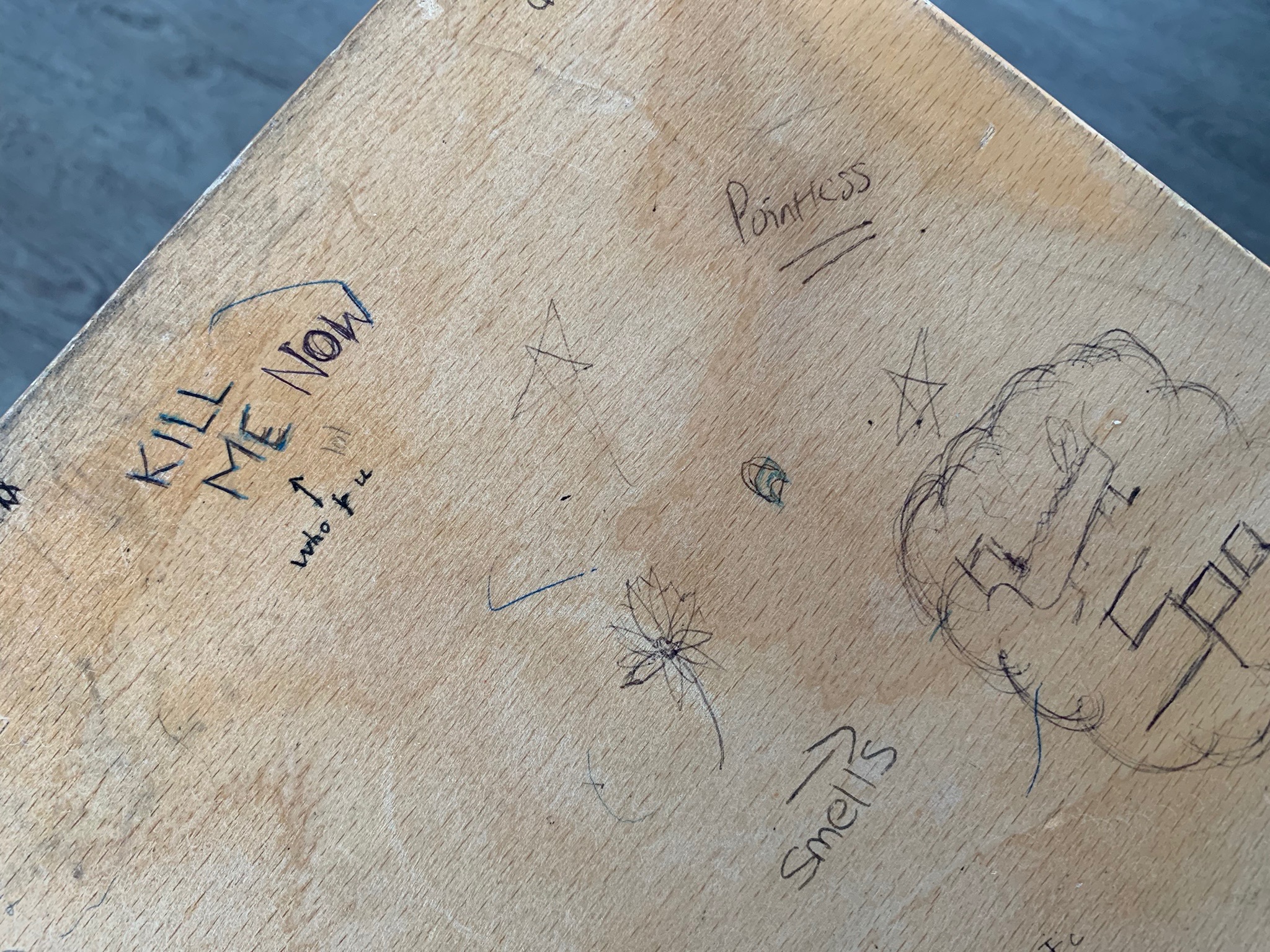
Photo: Grafitti’ed desk at the symposium
By lunchtime and two presentations later I was inspired by the imagination and sheer guts of what I’d heard but I also felt overwhelmed. Not only by the scale and urgency of the ecological crisis and the need to overturn (for starters) our dependence on fossil fuel – but also by my own powerlessness to find a response. In the face of the struggles faced by the speakers, the possibility of my own activism was fading like Marty McFly in that photo in “Back to the Future”. My agency was vanishing.
“Kill me now”, repeated my desk, the futility of it’s meaning lingering as I left the room early for lunch, needing space to think.
Subversion – making time to slow down and reflect
Over lunch I met artist Jon England who does work exploring remembrance and commemoration. As we shared impressions of the morning, we talked about activism for introverts and agreed we both felt lacking in some of the courage needed for what we’d heard that morning. Jon went on to tell me about a fascinating piece of work he’d done where he’d supplied servicemen and women who were on tour in Afghanistan with ArtKits, the aim of which being to smuggle in a possibility for recording their experiences and reflections there. He described the unusual path this work had taken as he navigated the command and control structures of the military – where certain thresholds could not be crossed, some doors were firmly closed whilst others were wide open. The activism he carried out required sensitivity and a measured quality in order to deal with the power structures he bumped into along the way. Just like Suzanne, no bricks could be thrown here.
As the sublime music of guitarist song-writer Kitty Macfarlane washed over us at the end of the day, I finally relaxed. “I needed that”, smiled James Aldridge, an artist whose work I had admired for a while on Twitter and fellow member of the audience . James’ response to the ecological crisis through his work is thoughtful and reflective. In a recent article for the dark mountain project (which I highly recommend) he wrote:
“I keep hearing that we need to act urgently, but we also need to slow down, to access ways of knowing that are about dialogue and relationship”.
Everyday activism – an ambivalent but connected place
As I slowed down and listened to the music, I knew there are no easy answers as to this puzzle of what my activism or ‘response’ to the state of the world might look like. That question is too big to bite off and chew in one go. Instead, smaller questions were asking themselves easily and clearly:
‘what can I be courageous about?’; ‘when might I need to disobey or not comply?’
I think these are worth asking daily. I’ve written before about extinction rebellion and that birthing a new era will take all kinds of positions. I know my activism is to do with occupying an everyday, connected place. This is an ambivalent and sometimes confusing place – but not a nonchalant one. I won’t etch my check-out message on the desk even if I’m very scared at times.
Through the day I had been witnessing all kinds of brave acts of courage and disobedience– visible and invisible- from all types of people. From Suzanne’s RBS theatrics to Jon’s subversive Art Kits in the army. From Robbie’s hijack play to James’ deep work on dialog with nature. Working to articulate and connect my activism to theirs feels increasingly important. Yet as I drove home, the image that played on my mind was that of the art student in the row in front of me. I’ll never know why he wore a check cloth and ski-mask over his head – but I like to remember him as a symbol of difference, subversion and courage. Hiding in plain sight and living with the consequences.
Notes
[1] See for example “RBS faces AGM protests over tar sands cash”, 19 April, 2011. The Independent newspaper
Thank you for reading! Feel free to share using buttons below or you can subscribe (using the button above on the r.h.s.) to the blog to have new postings mailed to you.