
Blog
A quieter pandemic – parallel stories
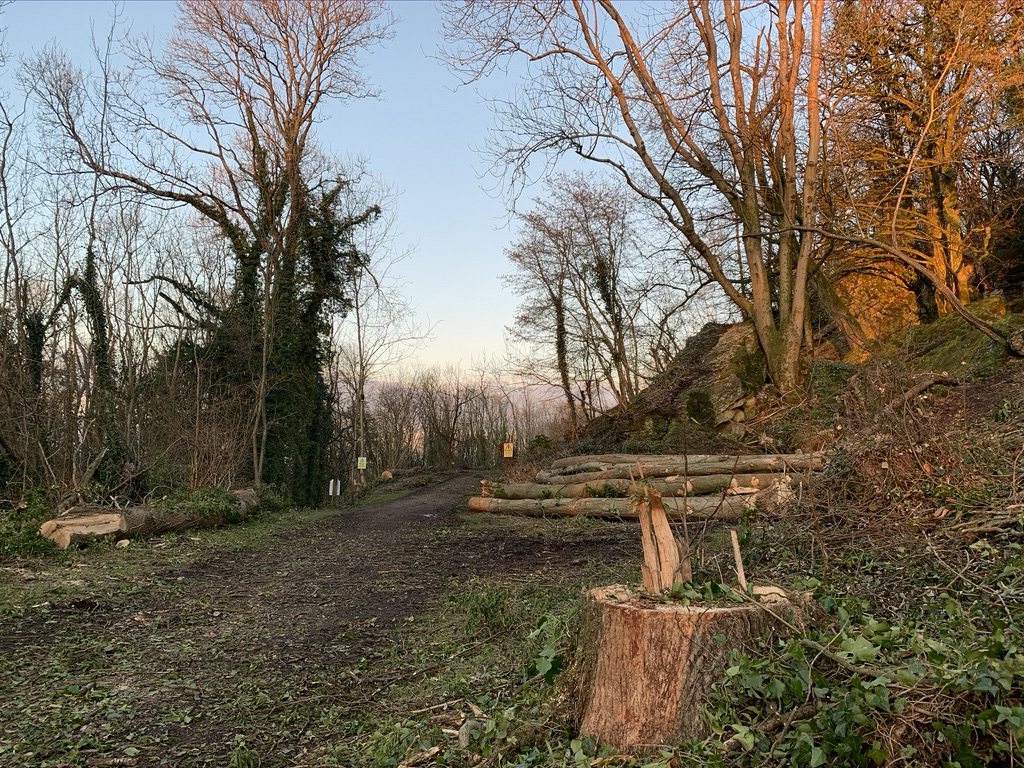
Tree felling in my local woods, March 2021
Walking plans
“Half of the arboretum is closed”, said G “should we meet anyway?”
“Oh yea”, I said, “I noticed that too – I think it’s something to do with Ash dieback – they said they are clearing away the infected trees”.
“Let’s meet anyway”, we agreed. The arboretum runs over several acres after all. There’d be plenty of trails and paths in the open part.
So, a few days later we met and walked, side by side, by a metal mesh fence that divided the open parts of the woodland from the areas where work was being done. We’d plenty of news to exchange – how our families were faring with Lockdown for one, and how G had got on with her vaccination for another. Occasionally I looked absently beyond the fence. There was no obvious activity. Just a clearing – wider than before. Lots of trees stacked in triangular piles.
Local disruptions
A week later, I discovered that similar work was going on closer to home. I’d set out on my usual daily walk only to find yellow and black tape cordoning off several of the paths. “What on earth is happening in the woods?”, I said on my return. “Yea – I think it’s something to do with Ash die back”, said my partner A. He was chopping onions and the radio was on in the background. “why don’t you check the website?” he suggested. “Oh, I’ll find some alternative paths” I said drawing up a map in my head.
The topology of the woods
There are three stratified paths in my local woods that run in parallel. The top path runs by Browne’s Folly – so named because it is a stone tower with no obvious purpose to it. This top path looks down on a bluff below, then Solsbury hill and onwards to the city of Bath that spills out eastwards from the confines of its ancient hollow. The middle path is the arterial one – it runs all the way through the woods – taking you to some ancient yews and hidden stone quarries – before suddenly dropping back onto the main road. Then there is the bottom path that hugs the top edges of the fields where the wooden stile is. A network of smaller paths drain from top to middle and down to the lower path – only recently mud-hardened after a winter of rain. This is the topology, the map that is in my feet and my brain when I head out, most days, to take a walk.
Disrupted paths
That map was all messed up now. Each day I’d set off on one path only to be blocked by a thicket woven across the path with a make shift “keep out” sign. I’d backtrack and set off down another only to meet a sign: “Private – Keep out”. “Forestry operations”. Last Friday, not to be thwarted, I threaded my way up a steep path from the stile to the arterial path. If I headed southeast I would reach the yew trees at the far end of the woods. But when I puffed onto the middle path, and lifted my eyes from my boots, I realized at once that I had accidentally stumbled into a forbidden section. It was only then I stopped. And finally paid attention.
Stillness
Trees were strewn in all directions, as though felled in a hurry. Caterpillar truck tracks a foot deep were hardened in the mud. All was quiet. Still. A tinge of aftermath hung in the air. “This place is decimated”, I thought.
Something to do with Ash Dieback
Something to do with Ash Dieback
Ash Dieback: I finally heard these two words. Saw them. Felt them. Standing there. I was astonished.
Chalara
Chalara is a serious disease caused by a fungus that effects the vascular system of trees – in other words the fungus interferes with how a tree transports its water. When the crown of the tree becomes infected, the tree starts to die back. It becomes brittle and dry and so it needs to be felled.
As I stood there, I couldn’t help but think of the contrast to our own pandemic – the sheer noise and energy of it. Here all was quiet. Yet it felt fully parallel and connected. If we humans are being deprived of air in one pandemic, it would seem that these trees are being deprived of water in another.
Reaching for a story
I wasn’t quite sure what to make of this scene. It was ordinary in one way – just some felled trees – but it felt extraordinary in another. I scrabbled around in my mind to find a way to think about it. And just like, that I found the perfect story. Of course: hadn’t I met an Ash tree once? Just over a year ago.
The perfect story
This perfect story took me back to February 28th 2020. I often think of that day as the day before the pandemic began. An artist friend James Aldridge had come to a poetic activism gathering we had held in Wiltshire. It was a rain-darkened day and we had made ourselves cosy in the hotel meeting room – the lamps lit early and the oak table warm. There were ten of us or so. As we arrived there was laughter and chatter. We shook hands, and some of us hugged. Clinked our coffee cups. One guy there had a cold and sneezed. No-one batted an eyelid.
Wasp’s nest
Eventually we’d settled around the oak table. Each person had brought an object that said something in some way about their understanding of “poetic activism” in their lives. My friend M, a social entrepreneur, who was getting an Urban garden off the ground, had brought a wasp’s nest. I still remember how she held it out cupped in both hands. It was so fragile, and she held it so gently. Just like the project she was nurturing, someone said.
James and Ashley
James was an artist and he’d brought a round cut-out section of an ash tree. He called it Ashley – some days a he, other days a she. Ashley was robust and you needed a bit of muscle to lift him (it was a ‘he’ day). As he lay on a side table I rubbed my hand following the warm grain of the rings. By way of explanation James told us about an arts project called Ash Tree Stream that he had created with Andover Trees United. He was working with children from local schools to learn about Ash trees and Ash dieback disease within the context of local cultural heritage and climate change.
He told us how he and the kids had gone out and sat among the Ash trees, and made rubbings and all kinds of artwork together. Towards the end of one session, he said, two children had spontaneously hugged the Ash tree and, just as they were leaving, another boy had gently placed a painted stone at the foot of it as an offering. He told us how touched he was when he saw this. He writes about this in his blog – it’s well worth a read.
Felling the Ash
James then told us how soon afterwards the trees they had been amongst were felled and he and the kids went up there to witness it. There was excitement and mixed feelings for him he said. He described how on his blog:
“As the tree came down, people cheered and clapped the foresters. For me it was a poignant and moving moment. As the tree that I had witnessed children thanking and hugging the day before crashed to the ground, I felt my chest tighten, and I walked forward to touch and quietly thank the tree myself, before taking away a few black budded twigs”.
James Aldridge, March 2020
Poetic move
He was offered a piece of the tree and he had thought long and hard about what to do with it – what could he do that would honour the tree and be true to the fullness of all that was happening. He writes about this too in his blog. Finally, he realized what he should do:
” I thought about how I could take the tree to meet people who couldn’t be there, by taking a round from the stem to events, workshops and other meetings, sharing the tree’s story and triggering conversations about trees, climate and biodiversity”.
James Aldridge, March 2020
So he sanded the piece of the tree and that’s how it came to be on that side-table in Wiltshire a year ago. It had been one of its first outings. “Pleased to meet you”, I had said at the time, rubbing my palm following the grain and rings in clockwise motion. I can feel its touch still under my finger tips.
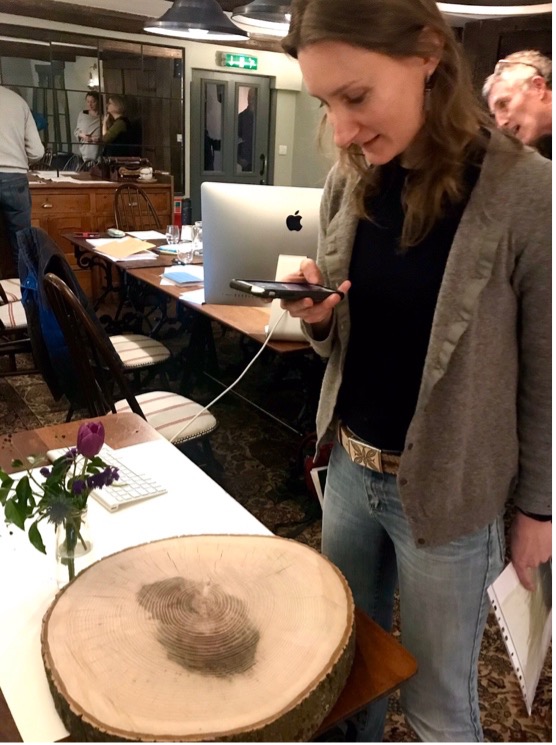
Ilma encountering the ash tree section on its first outing in February 2020. Photo credit: James Aldridge
Breathing the loss
My chest had tightened too when I found myself standing in the aftermath of the Ash felling in my local woods. I held my breath. It was as though in that strange stillness I could hear the silent loss that had been around me all along.
It’s hard to know how to really be with these losses of our time – the diminishing numbers of our bumble bees – the Regent Honeyeater bird that has forgotten how to sing its own song – the loss of the Ash trees – the unspoken loss of human life and hope in the midst of our own pandemic.
Fleeting visits
You can’t keep going over all these losses all the time can you? It’s surely too much. Even if you wanted to, I don’t think you can realize the full extent of loss until it’s ready to reveal itself to you – in mind and body. These are fleeting moments. I’ve even come to see my moment of realization in the woods as a gift – a temporary deeper understanding – a visit from the bigger story we are living in. It’s hard not to look away – to slam the door when that visit comes.
The bigger story
Having a poetic place to go helped me not slam the door. In that fleeting moment I was grateful for James’ story – and for the move he’d made – taking Ashley out to meet us a year before. It helped me make sense of things now That surely is one of the roles for poetic activism – to help us hear and listen to what is happening – and to stay with this bigger silent story when it knocks on the door and says hello.
Thank you
Thank you for reading! Feel free to share using buttons below or click on the subscribe button here to hear about future postings
Notes
(1) You can read more about the Ash Tree Stream project here and more about James Aldridge’s work on his website http://www.jamesaldridge-artist.co.uk/
(2) James blogs about his work on https://jamesaldridgeart.wordpress.com/ and the story re-told in this blog is told by James on https://jamesaldridgeart.wordpress.com/2020/03/17/one-ash-experiencing-connection/