
Blog
Crying our way to the future – the wisdom of tears
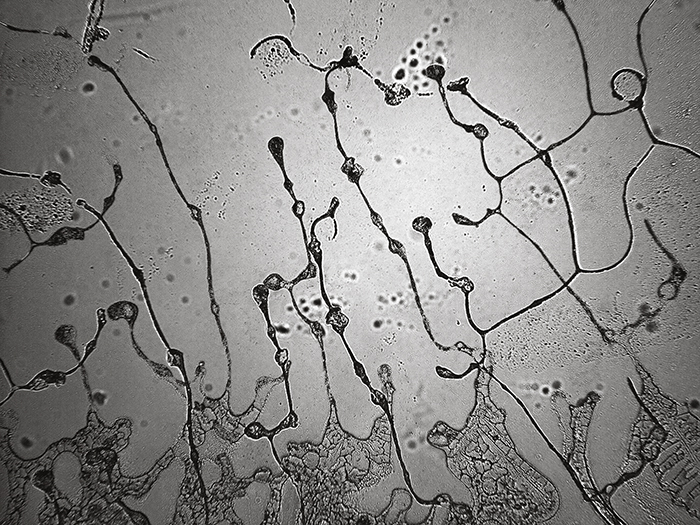
Tears for those who yearn for liberation. From The Topography of Tears, © Rose-Lynn Fisher
Last Saturday morning in Bath, UK
“I must write another blog soon”, I said to my husband A. last week.”What could it be about? “
“Anything”, he said, “Just not another one about Brexit”
“Oh”, I said.
“But I’ve been really wondering about something…”
“What?”, he said while scanning his phone.
“Do you think Theresa May ever cries about Brexit? Do you think she ever goes home and just dissolves in tears and says I don’t know what to do?”
“Oh for goodness sake”, he says. “That’s still about Brexit!”
“No it’s not”, I say. “It’s about how we move from the present to the future. I think crying may have a part to play”.
Bear with me. This blog is not about Brexit. Instead, it is about tragedy, tears, and the role they might have to play in our future.
Before we start though you may want to think about two things – when is the last time you cried? And what kind of tears were they?
Different kinds of tears – Rose-Lynn Fisher
During a tumultuous time in her personal life, the photographer and artist Rose-Lynn Fisher found herself crying a lot. As she did, she started to wonder if there are different kinds of tears. So, she put slides of dried tears under an optical microscope and viewed them, mused on them and photographed them in black and white. She added titles that evoked or described what she saw. Sure enough, a rich and surprisingly wide terrain of emotion came into view: ‘tears of grief’ had aerial-view type spaciousness. These compared with the dense leaf-like patterns of smarting ‘onion tears’. And different again were the kinds of tears that squeeze out when laughing so hard, you cry or the bubbling tears of ‘overwhelm’. These were different again from the darker, denser pattern of tears of compassion.
The resultant topography of tears has been exhibited in galleries across the world. In the introduction to her book of the same title, Rose-Lynn writes that the series is like an:
‘ephemeral atlas’ – it is a ‘momentary emotional landscape, transient as the fingerprint of someone in a dream’.
Rose-Lynn Fisher
I could gaze at Fisher’s images all day – the fleeting patterns recall lace, filigree, droplets and geology. They remind me of stories – of staring at rain on windowpanes, of peeling onions with my grandma, a J-cloth over her nose. “stops the tears you know” she used to say. The collection makes fleetingly tangible an unknowable hidden world where chemistry meets emotion. I feel invited into aesthetic connection with that world as I contemplate these images and inevitably they make me wonder what different kinds of tears I cry.
My tears
I do have a range. I’ve got pathos tears – they well up suddenly when I see someone doing or saying something quietly dignified. They relate to my connecting tears – ones that start up in one person’s eyes and seem to finish in mine. In one small group I work with tears seem to travel around in this way – flashing through like a brief charge that then ebbs. Then there are my hurt, angry tears – when a fiery frustration suddenly switches into something helpless. There are those of sadness and love – tears that sprout up when you love someone a lot but you suddenly become present to the fact you might lose them.
But then there’re a whole lot of tears that defy categorization – that simply well up from nowhere. Just last week I cried in a conversation I was having with a colleague for no reason that I could name. There was knot of emotionality that had something to do with effort, sadness, loss and delight. “Sorry”, I said as it is typical to do in such situations. “I didn’t mean to upset you”, said my colleague. “You didn’t”, I said. Later I thought that these tears may have had something to do with beginnings and endings. And lo and behold, in her topography, Rose-Lynn has a picture that conjures these up too.
Crying as a way of knowing
However vainly I may attempt to categorise my tears there is no doubt that crying often helps me shift mode. When I cry, I cannot fail but be present to the exigencies of that much sought-after present moment. I start to think those tears that spray or trickle out are interesting little beads of ‘data’ about that present moment, and whatever qualities of sadness, loss, overwhelm or laughter it may contain. I cry because I care, connect or simply don’t know what else to do.
And yet when it’s over, the landscape I open my eyes to can appear different. The person’s struggle has meaning again; the love has been affirmed; the mirth of the joke has subsided. The situation can continue. Or the onions may have been chopped and lost their vigour. Things appear a little differently.
Crying over spilled milk
I have written in a previous blog how I am deeply admiring of the 16-year old Greta Thunberg’s climate activism and how her clear messages are reaching those new generations of children who marched just last Friday (15th Feb 2019) for the climate. If I dwell on this for a minute, fingers on keyboard, I can feel a sinus pain shoot through my nose and tears prick my eyes. I don’t cry often about the climate situation – despite all I have written on this blog about its tragic quality and my search for a kind of realistic hope that is not denying. Yet I still find it hard to confront emotionally. It’s only by thinking of my children and the next generation that I can.
And I only cried once about Brexit – the day we heard the results of the referendum. These were tears of sadness and incredulity. It is no good in crying over spilled milk that’s true but crying a little might help you see the milk and the shards of glass within it more clearly.
Who’s crying these days?
So I do wonder about who’s crying these days. I think I’d trust more an MP who occasionally gets a catch in their throat, or who sometimes shuts the door on their office, holding their back against it whilst they cry quick overwhelmed tears of frustration or outrage about Brexit. Do they? Somehow I doubt that Theresa May and others in parliament allow themselves helpless tears after a failed visit to Brussels or one of those awful deadlock days in parliament. I hope I’m wrong. In uncertain times, being able to step from knowing to not knowing to despair and back out again takes real wholehearted courage. Yet it’s a different kind of courage to the particularly tragic, dogged courage we’re currently seeing. This grit, suggests columnist Rafael Behr in a recent article, is where the ‘stiff upper lip [would rather be] chewing itself to pieces than name the cause of our suffering’. That cause, he says, is Brexit itself, a drug and addiction. That article nearly did make me cry – it reminded me how much I love the UK and the people in it.
The wisdom of tears
In my view, anyone that occasionally buries their head in their hands and sheds a few tears along the lines of: ‘what have we done? what are we doing?’ and then asks ‘so, what now?’ is tapping into emotional and connected possibility. Being open to cry about something could even be taken as a sign of quality – of being equal to it – having the requisite emotional bandwidth.
Brexit may be the dress rehearsal for more difficult times ahead. When it comes to climate change there are ever more alarming stories of species loss not least the collapse of insect populations, underestimated feedbacks and over shooting temperatures. I’ve mentioned before the philosopher John Foster’s work on climate denial. He says that the kind of hope we need is one that also acknowledges tragedy and loss.
So next time you cry don’t say sorry. Give yourself a comforting pat on the back – for allowing your tears to speak. And as you do, take a moment to imagine the pattern of your tears. Perhaps they look a little bit like this?
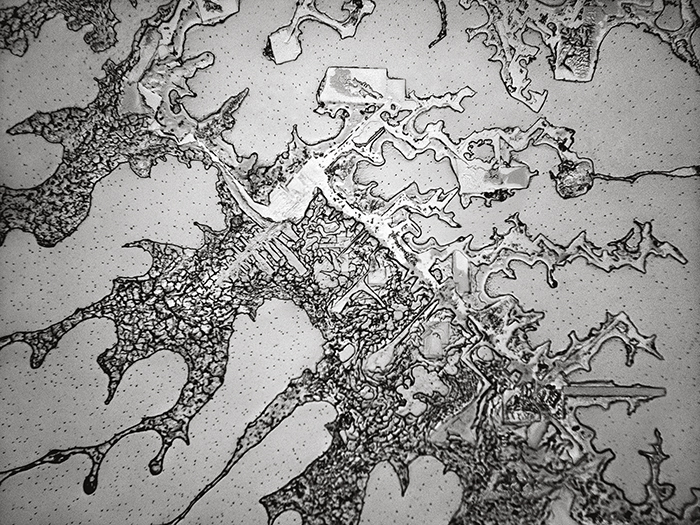
Tears of possibility and hope, From The Topography of Tears, © Rose-Lynn Fisher
Acknowledgement
With thanks to Rose-Lynn Fisher for permission to reproduce a couple of her photographs here.
See more on her website
Her book “The Topography of Tears” is published by Bellevue Literary Press www.blpress.org and is available on Amazon here